Well knit: Belfast Mini Mills

Posted on January 02, 2026 | Atlantic Business Magazine | 0 Comments

How a P.E.I. manufacturer found a niche, and held it for over 35 years
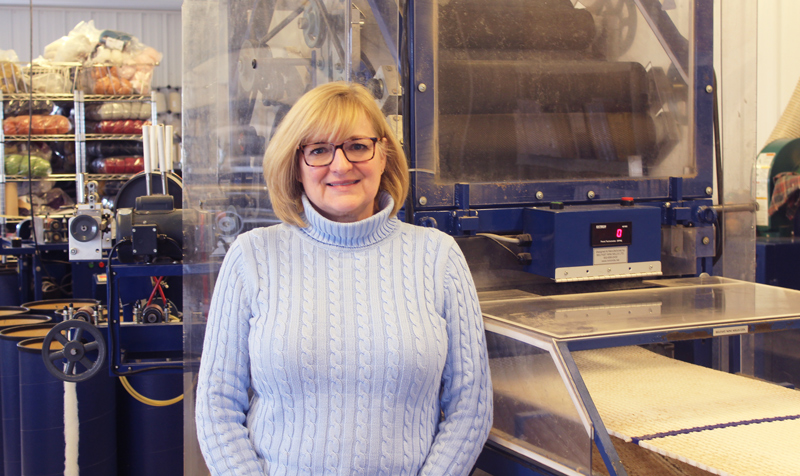
Kim Doherty-Smith standing in front of a carder. (Photo by Kevin Yarr)

Like many small businesses, Belfast Mini Mills was born out of frustration. When its founders wanted to do something, but found they couldn’t, they didn’t accept it as just one more of life’s frustrations. Sheila Sutherland describes their response differently.

“This is ridiculous.”

It was 1990. Sheila and her husband Lawrence were living in Rock Creek, in the British Columbia interior, tending a flock of about 90 head of sheep and operating Mountain Loom Company, which made and sold looms to crafters.

What Sheila Sutherland found ridiculous was a gaping hole in the middle of the process for making their own end product. They could grow their wool, they could weave their cloth, but they could not get yarn made from their own wool. She had tried, sending her wool to a mill in Alberta.

“I knew when I got my fibre back it wasn’t mine,” she said. It was not the quality she was expecting given the wool her own animals were producing. “In the big mills, they mix all of the fibre that they get in from everywhere, all in one. So that, just that moment, was when the idea came.”

Hazel Spencer with Sheila Sutherland sitting behind a loom (this is not a loom that they made themselves).  (Photo by Kevin Yarr)

Why not have their own mill? Why not raise the sheep, shear them, wash and card and spin the wool into yarn, and create an unbroken process from sheep to sweater?

Their research found that a mill which would work on the scale they wanted was very difficult to come by. So they asked themselves, is there an opportunity here? Their son-in-law, Doug Nobles, thought yes.

Nobles worked in construction and was accustomed to repairing his own equipment. He began reading up on how machine carders worked, visiting mills that worked on a large scale, and prototyping a machine small enough for someone to feed in a basket-load of fibre from a few animals, and get their own product out the other end.

“The building of it, the machining of it, we could do that. It was no problem,” said Nobles. “It was just understanding how it all worked and how to make it smaller. When you make things smaller, there’s a lot of complications.”

Sometimes the cost of scaling down the size of a particular part was prohibitive, which meant finding a new solution. “We had to redesign how a lot of things work. Quite a bit of our equipment is just special to us,” he said.

After about a year of fiddling and prototyping, the fledgling company had a working product.

What their research could not tell them was that they were stumbling into a sector that was being reborn. Now known as fibre arts, it includes weaving and knitting as well as felting, and not just sheep but a whole range of other animals.

“Llamas and alpacas just came in at the same time, so it was just the perfect scenario, really,” said Sutherland’s daughter Hazel Spencer. She would eventually take over the business along with Doug Nobles and her twin sister Linda, Doug’s wife.

“More and more people were knitting—it seems to go in phases—and at that time, a lot of young people were getting into the fibre arts, and lots of felting and stuff like that. There were so many different areas that fibre applied to that it was just a roller coaster ride of possibilities,” said Spencer.

Belfast Mini Mills carder (Photo by Kevin Yarr)

They began to make some sales in the southern United States. It was one thing to be making wooden looms in the B.C. interior, but fabricating from metal was another matter. Getting the steel in and the completed mills out was inconvenient, and if they were going to move, they decided to seriously reconsider their location. They knew from the loom business that the eastern U.S. and Europe would be major markets for them. The east coast of Canada was an attractive option.

Ultimately, they decided to move to Prince Edward Island. They made the move in 1996 and the company took its name from its new home in Belfast, P.E.I. Part of the attraction was P.E.I.’s low property prices. The assembly plant is just a 15-minute drive from the Nova Scotia ferry terminal, with the port of Halifax two hours on the other side of that ferry ride. An industrial park in Halifax might have been more practical, but the family didn’t want to give up rural living.

“There was [Charlottetown] for anything we needed. It was the ideal location,” said Sheila Sutherland.

As interest in fibre arts grew, so did the idea of establishing wool mills at cottage-industry scale. While Europe and New England were early target markets, the company began attracting interest from much further abroad. “We were getting customers coming, like from Bolivia, Argentina, and they would come and stay with us at the house,” said Sutherland. “We did a lot of entertaining.”

The company now employs 17 people, including service technicians who travel the globe and workers in two plants, the assembly plant in Belfast and a parts-manufacturing facility in nearby Murray River. There are customers in close to 50 countries, and they add about seven new customers a year. The suite of machines to turn a sheep fleece into yarn costs about $250,000, but some will start smaller, perhaps creating felting instead of yarn. Current customers also keep them busy with expansions, adding about another two fully operational mills’ worth of business a year.

Belfast Mini Mills has customers as far away as Australia and as far south as Argentina, but the closest is operating just a few kilometres down the road.

Evan Nobles examining some roving (Photo by Kevin Yarr)

Unlike Sheila Sutherland, when Kim Doherty-Smith of Fleece and Harmony Woolen Mill first started thinking about producing yarn from the sheep she was raising on her 100-acre farm, the solution could hardly have been easier. At the time, Belfast Mini Mills had one of its own mills operating on site and did custom milling of other people’s wool.

But about 10 years ago the company shut down that part of the business. Doherty-Smith, who had seen a lot of success selling her wool at a shop in Charlottetown, had a decision to make. “I went down to see Linda, and first I started begging for her to do my wool again. And then I was afraid to ask the question, about, what about if we bought a mill, but she asked me,” said Doherty-Smith.

“And that’s how I ended up with a mill.”

Fleece and Harmony have benefited from the same growth in fibre arts that Belfast Mini Mills has, said Doherty-Smith, particularly during the pandemic. “Everybody was at home. People picked up knitting. If they weren’t making sourdough, they were knitting, or while they were waiting for their sourdough to proof, they were knitting,” she said.

The impetus for setting up a manufacturing business with a cottage-industry-scale woolen mill has something in common with the impetus to take up knitting: the desire to make something you can hold in your hands, to see something through from start to finish.

“When 9-11 happened, we had a big surge of orders, because at that time, people were thinking, well, maybe I don’t want to be doing my office job for the rest of my life”

— Hazel Spencer

“When 9-11 happened, we had a big surge of orders, because at that time, people were thinking, well, maybe I don’t want to be doing my office job for the rest of my life,” said Spencer.

In 2023, the second generation of the family, who had been running the business since their father, Lawrence Sutherland, died in 2004, decided it was time to retire, and passed on the business to a third. The Nobles’ sons, Evan and Matthew, have taken over assembly of the machines and sales and service, while Spencer’s son Tyler operates the parts fabrication plant in Murray River.

There are still no other companies out there building mills at this scale, said Evan Nobles. There is Brother Drum Carder in Oregon, but they specialize in carders and don’t offer the full suite of machines that Belfast Mini Mills does. The Italian company Ramella also sells small-scale mill equipment, but their machines are still larger than Belfast’s, and a full suite, said Nobles, comes in at about twice the cost.

But being virtually alone in the market has not stopped the company from innovating.

Nobles showed me around a new addition to the plant, a powder coating facility that includes an oven you could drive a small car into. “We used to spray paint everything, and that just wasn’t as durable. It was all right, but at the time, powder was so expensive that we couldn’t justify it,” he said. “[Powder coating] lasts for a lot longer, and the oils and stuff in the fibre don’t eat through it.”

They are also looking at making a larger carder, which Nobles describes as the bottleneck in the company’s suite of 18 machines that take a fleece and ultimately turn it into a package of yarn. Their current carder will process about 15 kilograms of sheep’s wool a day.

Making a larger carder is not an issue in itself, but Belfast Mini Mills equipment is specifically designed to fit into a relatively small space. The idea was to make setting up a mill affordable, and that’s not just about the mills themselves. It’s also about being able to fit them into a space that the customer already has available, like a garage or a barn.

With a new machine they are aiming for maybe 22 kilograms of wool a day. There’s two ways of doing that: make the drums that are carding the wool wider, creating a taller machine, or make them longer, resulting in a wider machine.

“This one’s already so wide, that’s why I’m nervous about making it wider because then we don’t want to be getting it too far away from the cottage industry,” said Nobles. “That’s the whole idea. You want it small scale.”

They may not be big, but they’re small. It’s the idea that has carried the company through its 30-year history.


Leave a Reply

Your email address will not be published. Required fields are marked *

Comment policy

Comments are moderated to ensure thoughtful and respectful conversations. First and last names will appear with each submission; anonymous comments and pseudonyms will not be permitted.

By submitting a comment, you accept that Atlantic Business Magazine has the right to reproduce and publish that comment in whole or in part, in any manner it chooses. Publication of a comment does not constitute endorsement of that comment. We reserve the right to close comments at any time.

Partner

With ABM

Help support the magazine and entrepreneurship in Atlantic Canada.

READ MORE

Stay in the Know

Subscribe Now

Subscribe to receive the magazine and gain access to exclusive online content.

READ MORE
0
    0
    Your Cart
    Your cart is empty