Account Login
Don't have an account? Create One


The Newfoundland and Labrador Construction Association is proud to partner with Atlantic Business Magazine to share the story of an industry that quite literally builds our province.
Construction remains one of the most powerful economic drivers in Newfoundland and Labrador. Every project delivered strengthens communities, creates opportunity for families, and generates significant economic activity across sectors. The multiplier effect is real—every dollar invested in construction produces far-reaching benefits for businesses, workers and the broader economy.
This special publication highlights several of the issues shaping our industry today. From advancing apprentice-ship pathways and encouraging young people to consider skilled trades careers, to modernizing procurement and expanding opportunities for local contractors, these conversations are essential to ensuring the long-term sustainability of our sector. We are also proud to continue advancing initiatives that support women in construction, recognizing the tremendous talent and leadership that women bring to our industry.
Our flagship events bring the industry together to learn, collaborate and celebrate excellence. The NLCA Build Expo continues to grow as one of Atlantic Canada’s largest commercial construction expos, where contractors, suppliers, owners, and government partners connect to explore new technologies and opportunities. Later this year, we will also host the Women in Construction Conference on November 6, followed by the ROCK Awards Gala on November 7, two important events that highlight leadership, innovation, and the people driving our industry forward.
I would like to extend my sincere thanks to our members for your continued support of the NLCA. Your engagement, expertise, and commitment strengthen our Association and help ensure the construction industry in Newfoundland and Labrador continues to grow and succeed.
Together, we are building more than projects—we are building the future of Newfoundland and Labrador.

On behalf of the Board of Directors, it is my pleasure to welcome readers to this special Newfoundland and Labrador Construction Association feature with Atlantic Business Magazine.
The construction industry plays a vital role in the health and prosperity of Newfoundland and Labrador. Our members build the infrastructure that connects communities, supports economic growth, and creates opportunity across the province. From roads and hospitals to commercial development and community projects, the work of our industry is foundational to the future of our province.
As Chair of the NLCA, I am committed to ensuring that the voice of our industry remains strong and focused. Advocacy will continue to be a central priority. Our Association will continue working with government and industry partners to support sustained and strategic infrastructure investment – investment that is planned, predictable, and ready to move forward. When projects are shovel-ready and supported by multi-year planning, contractors can plan, mobilize, and deliver with confidence.
Workforce development will also remain a key focus. Encouraging more young people to pursue careers in the skilled trades and strengthening apprenticeship pathways are essential to ensuring our industry has the talent needed to meet future demand. At the same time, initiatives such as Women in Construction continue to create meaningful opportunities for leadership, mentorship, and career advancement.
Finally, I would like to thank our members for your continued engagement and support of the NLCA. Your participation, ideas, and commitment are what make our Association strong and allow us to advocate effectively for the construction industry across Newfoundland and Labrador.
Together, we will continue building an industry that is resilient, innovative, and prepared for the opportunities ahead.
By Alexander Chafe

Hard hats & handshakes
“It’s critical. Everyone walks away smarter.”
“You have real industry decision makers there, that’s what makes this event unique.”
“It’s beyond beneficial. It’s a necessity that we sponsor and participate in the Expo every year.”
“Don’t think about it, just go.”
In an industry where relationships matter as much as materials, the Newfoundland and Labrador Construction Association (NLCA) Build Expo brings together buyers, suppliers, contractors, service providers and government. Having them all in one place facilitates industry insights, the discovery of emerging innovations and the forming of strategic partnerships. Now the largest commercial construction industry expo in Atlantic Canada, it was born from the wants and needs of NLCA members.
The NLCA itself was founded in 1968 and acts as the voice of Newfoundland and Labrador’s construction industry. Now with over 500 members, the organisation represents the sector to all levels of government and advocates for a strong future of construction in the province. In addition to member-focused services, the NLCA hosts a variety of events throughout the year to support networking, knowledge sharing and business development. Its Build Expo event launched in 2023 and was created in direct response to member feedback.
“There was a clear demand for a way to connect our members with buyers in the construction industry,” commented Stephen Short, Secretary-Treasurer and Past Chair of the NLCA. He explained that the Build Expo grew from a component of the organisation’s annual general meeting and conference. It started as a traditional trade show and has evolved into a true construction forum.

Over time, it grew into a two-day event including a number of components. The commercial trade show, for example, is where vendors set up booths to showcase their products and services. Attendees can also take in the conversation forum, where industry leaders discuss key challenges and trends in construction through fireside chats, panel discussions and keynote presentations. The networking continues during the event’s evening shed party.
Short says 2025 was a major year of growth for the event. Last year, a Women in Construction luncheon was hosted at the Expo, and its success inspired a half-day Women in Construction Summit for day two of this year’s program. It brings together industry stakeholders to explore ways of encouraging more women to work in construction and advance their careers in the industry.
Another major step forward for the event in 2025 was adding a reverse trade show, where different government departments set up their own booths. Given the government’s role as a primary purchaser in the construction industry, this presents a major opportunity for NLCA members and other attendees to connect with public-sector decision-makers. Based on positive feedback, the reverse trade show will reappear this year.
Justin Perry, Sr., Commercial ICF Specialist Canada at Nudura, said Nudura has been a vendor every year since the Expo first launched. As a national company, Nudura attends several industry events across the country throughout the year. But Perry feels the NLCA Build Expo is truly unique. Reflecting on what first attracted them to the event, he says it was having all the right people in one room. “It’s an event that stands out from the rest because you have real decision makers present. Attendees are predominantly construction professionals who are serious about making improvements to their craft and discovering real value,” he commented.

Connections at the event initiate further discussion and real business opportunities. Perry explained that, outside the event, landing an initial conversation is a major struggle for manufacturers and suppliers in the industry. At the Build Expo, attendees are like-minded professionals prepared to have direct conversations about products and services and are actively looking for new working relationships. Nothing is lost to administrative gatekeeping; you have a direct line of communication with someone who has the authority to act.
Perry said that government attendance at the event is especially valuable. “It’s not every day you get the chance to speak with government officials face-to-face,” he commented. With all levels of government present at the event, connections made at the Expo can have a real impact on business. For example, at a past Build Expo, Perry met contacts from two different government departments and invited them to an upcoming building summit that Nudura was planning. Several representatives from each department attended the event and brought architects from their professional network, which ultimately led to successful business opportunities for Nudura.
Family-owned Tucker Solutions has also been involved in the NLCA Build Expo since the beginning and returns this year as a Platinum sponsor. Matt Tucker, COO with the company, said it’s important to give back to an organisation like the NLCA, which has had a major positive impact on the province’s construction industry. Beyond that, the return on investment for their company’s sponsorship of the event is invaluable.
In addition to forming direct connections with government and industry decision makers during the event, Tucker explained that being a sponsor plays an important role in building brand awareness. Acknowledging the challenges of advertising to a commercial market, Tucker said partnering with a respected organisation like the NLCA and having Tucker Solutions’ brand front and centre at the event keeps their name top of mind. In the competitive construction industry, it’s important to be proactive. “Construction projects have lengthy development timelines. When they’re announced to the public, vendors have long been selected. You have to be ahead of the game and develop relationships, so companies think of you when opportunities come up,” he commented.

From event speakers to fellow vendors, Tucker said there’s always plenty to learn at the Expo. He remembers a particularly impactful discussion at last year’s event about the effect of new tariffs on the industry, which is a conversation he otherwise wouldn’t have had access to. Topics discussed at the Expo’s conversation forum are topical and directly beneficial to those working in the industry. Plus, there’s a lot to take in by walking the floor as an attendee. Tucker said he discovered a few suppliers he didn’t know he needed at past events. He has also taken advantage of the reverse trade show by visiting government booths to learn about the procurement processes for different public sector departments.
BELFOR Property Restoration, an event sponsor in 2025, has also experienced the increased brand awareness the Expo delivers. Christine Adams, Business Development Manager, said while developing new connections is always a goal, reconnecting with current clients is just as important. She explained that this often leads to more opportunities to work together; keeping in touch with clients helps maintain long-term business relationships.
She also feels that in-person interactions at events like the Expo help build a more genuine connection. “I’m a firm believer that being in front of someone face-to-face is more powerful than speaking with someone behind a screen. It’s more personal,” she commented. This approach helps the BELFOR team build a strong network and trust with clients, which is particularly important in its line of work. When disaster strikes, clients want someone they trust to take care of their property. So, attending events like the NLCA Build Expo keeps BELFOR top of mind and helps their team stay engaged with clients and industry partners.

As he and his team prepare to attend the NLCA Build Expo event for the first time, Ken Rideout, Fire Protection Regional Manager at Troy Life & Fire Safety, is excited about making new connections. This year, Troy will be a gold sponsor and have a commercial trade show booth. Rideout says their team looks forward to the professional development opportunities of attending the event by connecting with leaders across the industry, from manufacturers and contractors to government officials. “It would take well over a year to meet with all those people outside of the event, and some we’d maybe never have a chance to connect with,” he commented.
In addition to networking, Rideout is keen to discover the latest industry innovations at the event, as well as educate attendees about Troy and fire safety code requirements. Meeting in person opens conversations and allows Rideout to showcase the breadth of their company’s products and services. Also, code changes happen often and can be hard to keep up with, so having their team on the ground at an event like the Expo gives them a chance to explain requirements in plain language. After years of watching from the sidelines, Rideout says he can’t wait to be part of the action and experience everything the event has to offer.
The NLCA Build Expo is constantly growing and evolving, building a brighter future for the province’s construction industry.
Back to Top

Can she build it? Yes, she can!
When you consider that for every nine men employed in the Newfoundland and Labrador construction industry there is one woman, it’s hard to believe how far women have come in this industry and easy to see how much room there is to grow.
There was a time, just a generation or two ago, when a woman would be laughed at—by men and women—for wanting a career in construction. Thankfully, decades of girls-in-STEM advocacy, higher education and progressive attitudes towards women and gender-diverse individuals have opened doors and broadened opportunities in, and for, the construction industry.
Tonya Knopp, P.Eng., is the Manager of Facility Engineering with the City of St. John’s—the first woman to hold that position. She was recently assigned a new role for the next four years, as Project Director/Senior Project Manager for a major expansion of the city’s wastewater management facility. Getting here involved a great deal of higher education (she’s currently completing a PhD in Civil Engineering), hard work, networking—and a thick skin.
“From my (engineering) class that had 15 women in it, only three of us remain working in the industry today. So that tells you a little bit about how women were perceived and how unwelcoming the construction environment was 20-plus years ago,” Knopp said, adding that she persevered and succeeded because she refused to be intimidated. “I wasn’t going to be deterred by anyone, man or woman.”
“Those of us who have been in the industry a long time, like myself, have seen the industry transition a lot in the last 20 years. But there’s still a lot of room for improvement to be done.”
–Tonya Knopp, P. Eng., Manager of Facility Engineering, City of St. John’s
It took a lot of gumption in the early years, as a young woman, to assert herself in the field. “Specifically in the shipbuilding sector or in oil refineries,” she recalled, “I would look around and I would always be the only female there. I’ve had a lot of rude things said to me, as I’m sure you can imagine, but I never let that stop me. I was very, very quiet when I first graduated from school. It took me a while to find my voice. But when I did, I used it effectively and respectfully, and I just demanded the people I worked with on sites treat me the same way that they would treat their mother.”
Lindsay Hynes, Sales Manager of Landscape and Masonry Division for Concrete Products, has been working in male-dominated environments since she was a teenager. “When I worked at Power Vac, I was 19 years old, the only woman with 150 men,” she said. There were times when her expertise was questioned and she felt intimidated on the job. Over the years, she said she developed a lot of empathy for men in an industry that was quickly changing around them. She acknowledged that hers is probably an unpopular opinion, explaining: “I find that you have to understand the construction industry had been male-dominated for so long. We’re (women) a new element and they need to be given a chance to accept that because, you know, it is different. I find, as a woman going into it, you have to be accepting of their lifestyles as well.”

Indeed, from talking to female construction professionals for this story, it is clear not “all men” have an issue working with women. In fact, some said that for all those men who try to hold women, there are just as many who celebrate and support them as allies, colleagues and mentors.
One such mentor connected Tzu-Hao Hsu with a construction-adjacent job at United Rentals, a position she would never have considered otherwise. “I came out of school with my business degree and figured I was going to go to the big fancy corporate building in the sky, so to speak,” she said. “He thought my attitude and aptitude would be a good fit for the industry, so he introduced me. I haven’t left since.” Beginning 13 years ago as an inside sales representative, Hsu learned everything she could about the business, from safety to logistics of dispatch, to its overall management, and worked her way up to Operations Supervisor.
While she didn’t start out with a dream of a career in construction, she says she can’t imagine where she’d be now without it. The industry, while it can be seasonal for some, is year-round for her. There will always be things to build, repair and maintain, meaning her employment is pretty stable, and the pay is very good. Beyond that, maybe larger than that, is how rewarding it is, partly because the work is so visible. Hsu says that some days she’ll be driving around the metro area with her kids in the car and they’ll excitedly point out their mother’s company’s job sites. “There’s a real sense of pride that comes from knowing the things I do have literally made physical landmarks—changed the skyline of the city and the community I live in,” she said.
“I love when I drive around and I see women on the rock trucks, and women on the big equipment and I think it’s awesome. If I had my time back – it was never something that was an option or even talked about for me when I graduated high school, for that type of work, trades or any of that. Now I’m like, I wish that was something that had been available to me back then because I think that would be so cool. I would love to drive a rock truck or a dump truck—or a concrete truck!”
—Lindsay Hynes, Sales Manager, Concrete Products
“Rewarding” was a common adjective among these interviewees, each time said with sincerity and appreciation. Hsu credited it for keeping her engaged in her job. Tonya Knopp recalled how, after switching her education path from medicine to civil engineering, she knew she’d found her calling. “I was really interested in (engineering and architecture), and I thought if I can be part of cool infrastructure projects, those would be cool things that I’m leaving in the community, things I’ll reflect on my whole career and look back and say, ‘I was a part of that project, and that project contributed to the community in XYZ way.’ I find that very rewarding,” she said.
The family of Valerie Penney, Senior Project Manager with rcs Construction, sees her work whenever they shop at the mall or the grocery store. In her first few years with the company, she oversaw the $100 million-plus renovation and expansion of the Avalon Mall in St. John’s. And while she considers that a highlight of her career so far, her current passion is grocery store renovations. She revels in the added challenge of these “live renos,” where the building under construction is also open for business and crews work around the clock. It ticks all the boxes for Penney, a civil engineer who was drawn to project management because no two days are the same. “At the end of a project you were able to see what you’ve done and take some pride and ownership of it,” she said.

Penney, who was recently named Chair of the Newfoundland and Labrador Construction Association (NLCA), has also been serving as Chair of the NLCA’s Women in Construction Forum. Launched four years ago under the direction of NLCA President/COO Rhonda Neary, the forum provides a safe space for women in the industry to network, learn from each other and share their experiences. Volunteering with Penney on the board of the NLCA are Knopp (Third Vice-Chair) and Hynes (Manufacturers, Suppliers & Services Section Chair). Until recently, Hsu was the Standard Practices Section Chair. They all credited the NLCA and the women-specific events with enriching their careers.
By participating in those (workshops), and being in board meetings, where everybody around the table is super accommodating and super friendly, it just gives you a place where you can relax. It’s not stressful, you can be yourself. The training sessions through Women in Construction really gave me a whole level of confidence going into these meetings,” said Hynes.
Said Penney, “When I started this (chairing Women in Construction), it was a huge space and platform for me. The amount of growth I got from that, being in front of people, stepping on a stage, doing those things has been immeasurable.”
“Women don’t keep people out of the table; they extend the table, they bring more chairs. We aren’t the gatekeepers; sometimes we’re the doorstoppers, keeping the door open so others can follow us.”
—Tzu-Hao Hsu, Operations Manager, United Rentals
Knopp, who is heavily involved with the WIC Forum, also volunteers in the community with a long list of women-centred causes including WISENL, Tequity+, PEGNL and YWCA. It’s very important to her, “given where I am and what stage I am in my career, to give back to my community and, more importantly, to provide supports for women who want to enter STEM, for women who want to enter the trades. We need them. We need their voices around the table. I want to see them when I’m on construction sites. I want them to have safe places to work, and I want them to be able to share their voice.”
Reflecting on her first WIC Forum experience, Hsu said, “It was one of the first times where I went into an industry event associated with the construction association and saw predominantly women vs men.” Networking woman-to-woman was less intimidating and she was able to make solid contacts.
About two years ago, Hsu was inspired to initiate regular meetups for women in construction. It was during a focus group, she recalled, when an established, widely respected professional woman shared how she is still sometimes disrespected on the job. “I was flabbergasted,” Hsu said, both to know that she wasn’t alone and also to discover that it could happen to someone of this woman’s calibre. What followed was the launch of the Women’s Coffee Circles, hosted by Hsu, where women drop in and network for an hour, learn from a guest speaker and share experiences and resources.

The most recent Coffee Circle provided Hsu’s proudest moment, she said. The guest speaker shared her personal stories of harassment, then asked those in the room if they’d had similar experiences. Several raised their hands and one shared information on how they dealt with it. “I had such a moment of pride and joy,” said Hsu. “We talked about this being a safe space for such a long time, but this is concrete proof of engagement that we trust each other enough in this space to come out with these personal and, at times, very traumatic stories. But it’s now a place where we can have these conversations because we know that we’re surrounded by our sisters, our compatriots, and it’s OK to come out and talk about it.”
The WIC Forum has been steadily growing every year. Even the number of male attendees has grown from one, an NLCA board member, to almost 10 per cent of the total at last fall’s event, according to Hynes. “They’re embracing it and they’re being allies for us.”
The construction industry is going to need all the allies it can get in the coming years. Hundreds of thousands of workers are due to retire across Canada this decade, and the push is on to attract and promote all genders. Not only is there a labour shortage, but there’s also a boom on the horizon in residential and non-residential construction as well as megaprojects. Opportunities for women to enter and advance lucrative careers in this industry have never been bigger—and there’s plenty of evidence that the industry would be far better off for having them.
“It really isn’t just about the hard hats and boots. Although those roles are very important, there’s many other sides to the construction industry. There are careers in engineering, project management, estimating, safety, technology, sustainability, finance and skilled trades.”
—Valerie Penney, Senior Project Manager, rcs Construction
“What I’ve seen from my own experience is that diverse teams help make better decisions. I think women often bring a different communication style, collaborative approaches and perspectives that are a little bit different,” said Penney. “I think in that team environment of what a construction project would be, I think having a woman involved is certainly going to help diversify those balanced teams, foster stronger culture and communication. It isn’t just a moral imperative, I think it improves performance, retention and innovation.”
Said Hynes: “We tend to be better multitaskers because we have no choice but to be multitaskers when you have a home life and a work life and everything else. I don’t want to say we work harder, but in a way we have to work harder to prove ourselves, so we do work harder.”
“Maybe it’s because we know coming in that we have to put in a bit more effort in some spaces,” added Hsu. “I find that women, once they’re locked in and remain locked in and are rewarded for their efforts, there are very few women I know who are not high achievers in this business. If they’re rewarded appropriately for their efforts and recognized, they’re committed, they’re passionate, they’re strong players for their teams and they are absolute go-getters.”

There has always been steady evolution in the construction industry. Equipment, safety protocols, even the materials used have changed over time. However, what’s happening now is a collection of relatively rapid changes for contractors and sub-contractors looking to land their piece of larger projects.
It is the era of Procurement 2.0, and experts say companies that have adapted to changes and that are prepared to embrace what comes next are poised to land work others increasingly will not.
According to longstanding participants in the sector, construction supply and service businesses in Newfoundland and Labrador have collectively built up all the right skill sets to contribute to just about any type of large construction project, from oil development projects and new mines to hospitals and highways. The ability to build isn’t the issue.
“They have the knowledge, they have the understanding of how it works, they understand how to build it. It’s just that there’s a lot more that’s coming that they have to be very open minded to, to ensure their business is ready for the types of projects that will come,” said Senior Project Manager at Marco Group, Ryan Davis.
Davis isn’t the only one marking the shift. Contractors are being faced with a lot of change before they can even land the job.
Thinking about the bidding and contract acquisition processes, the procurement models themselves are changing, becoming more detailed and difficult.
A Cost-plus contract, for example, might be used where the scope of work can’t be set in stone. By contrast, a lump sum contract would be on a fixed price for a very clearly defined piece of work. It only gets more complicated when you dig into the details around how a contractor covers the cost of the job and earns from it. For example, some models (as with “cost-plus” contracts) bake in a set profit margin for the contractor up front. The timing of payments can be an important detail in a very long list of details.
These days, one common feature in public contracting is interest in seeing joint ventures featuring local companies, particularly ones too small to bid a large contract package on their own. And joint ventures come with their own complications: there will be different ways of working from single-lead operations, different information sharing and decision-making processes. There is a new layer of human resources in some cases, certainly in legal consultation required, to assess legal agreements between partners. That’s in addition to the standard legal assessment of the work contract. From there, it’s not unusual to need ongoing advice for the duration of the partnership.
Consider something as foundational as the partners’ technology assets: A particular IT system might be preferred by a lead partner, which could mean new IT resource requirements for a company trying to join in.
While joint ventures can add levels of risk and complications, they also offer a new level of reward at the end of the day.

They have the knowledge, they have the understanding of how it works, they understand how to build it. It’s just that there’s a lot more that’s coming that they have to be very open minded to, to ensure their business is ready for the types of projects that will come.
—Ryan Davis, Senior Project Manager, Marco Group
AI-driven platforms and applications are becoming more common and even industry standard in some cases. It’s not unusual now to encounter questions on a company’s proficiency or willingness to engage with AI tools. It could come at the time of an initial partnership agreement, or when developing a bid.
“It’s the way the world is and going to be. So, you just can’t sit down and want our old methods that we’ve been doing for 30, 40 years. You have to be able to adapt and innovate,” Davis said, encouraging contractors to embrace the shift proactively, if they want to be ready to land the most lucrative opportunities.
“Hope’s not a strategy. So you have to be, as a company, you have to be able to manage your projects effectively,” Davis said.
As director of projects with the Cahill Group of Companies, Derek Brown said organizations like the Newfoundland and Labrador Construction Association can help in finding opportunities to familiarize yourself and your company with new tools, both those based in AI and otherwise. And it’s a good idea to learn before top-scale opportunities come along.
“If you’re not using technology to enhance your value-added proposition you might be short-changing yourself,” he said.
It’s up to company leadership to gauge what’s ultimately right for their business, but Brown encourages looking periodically at digital upskilling.
“I know all the talk these days is about AI. AI right now certainly is not in any threat of replacing trades workers who are out there building projects every day, but it can streamline and support those workers in a more efficient manner. So just knowing the products out there and seeing what’s the right fit for your company would be a really good place to start,” he said.
With new digital products and approaches to managing information, companies should also be mindful of requirements in cybersecurity. It’s about being prepared and showing you’re fully managing the risk. “Make sure you’re always in contact with your insurance company and that you’ve got that right coverage in place for that,” Brown said.
There have been changes in the approach to contracting resulting directly from changing government policy, with likely more to come. Issues including Reconciliation, environmental sustainability and even broad, Canadian economic sustainability have all come into play.
There are differing initiatives federally and provincially, but it helps to be aware of what’s happening at both levels of government as much as possible.
For example, Public Services and Procurement Canada is opening new opportunities for Indigenous-led businesses and Indigenous partnerships through an Indigenous-by-default approach to procurement. Non-Indigenous contractors are incentivized to partner with and sub-contract with Indigenous suppliers; generally speaking, these types of partnerships have a higher likelihood of getting approved for public procurement contracts.
In another example of policy promoting change, a “Buy Canadian” policy was announced by Prime Minister Mark Carney on September 5, 2025. Tied in with ongoing trade disputes with the United States of America, the policy came as an attempt to “protect, build and transform” what Carney and the rest of the government refer to as “strategic industries,” particularly things like aluminum manufacturing in Canada.
In some cases, policy changes can extend out of other areas of government investment, like research and development. An example is the National Research Council of Canada’s Platform to Decarbonize the Construction Sector at Scale, a program spending to accelerate productivity in future, through new developments in areas like digitalization and advanced construction practices. Started in 2023, the program is scheduled to be ongoing to at least 2029.

AI right now certainly is not in any threat of replacing trades workers who are out there building projects every day, but it can streamline and support those workers in a more efficient manner.
—Derek Brown, Director of Projects, Cahill Group of Companies
Being unsuccessful in landing public contracts can far too often be the result of a simple lack of preparedness. There are benefits to staying on top of certifications. It’s worth doing regular reviews on where the company stands with the latest industry fundamentals like safety management programs.
If a megaproject is anticipated, companies should know whether or not they need to go through a pre-qualification process in order to be eligible to bid on contracts when the time comes. It’s helpful to get through that process and get qualified sooner rather than later.
“If you have a question, it’s common practice to submit a request for information to get clarity on anything uncertain in the bid documents. They say there’s no such thing as stupid questions. When it comes to bidding, I think it’s important to get clarity, so you can protect yourself and make sure that you’re not being disqualified from bids unnecessarily,” Brown said.
Back at Marco, Davis suggested while local companies do their part in adapting to emerging challenges at speed, he would love to see even more labour force supports. He suggested new apprenticeship programs at the school level and continued professional development assistance for those in the workforce as possible supports.
“We have the capability. I can tell you that,” he said.
When chasing public contracts…

As a seventeen-year-old in the eleventh grade, Jay Avery started his day by catching a bus at 6 a.m., headed to the Aurora Mine Site near Fort McMurray, Alberta. There, he was training as a millwright, working with some of the largest mining equipment in the world. After finishing his 12-hour shift, he returned home and prepared for the next workday. He followed this schedule for about six months, working six days on and six days off. Avery then completed a semester of core high school coursework before returning to work the following September to start his senior year.
Now, at 18 years old, Jay is a few months away from graduating high school with hundreds of accumulated training hours for his trade and is well on his way towards a promising career.
Stories like Jay’s are an example of what’s possible when youth are given the right opportunities. The future of Newfoundland and Labrador’s construction industry workforce is uncertain. And the next generation is the answer.
According to projections from BuildForce Canada, an organisation dedicated to studying and supporting the construction industry labour force, up to 8,300 workers will have to be recruited by 2034 in Newfoundland and Labrador. This number accounts for an overall increase in labour requirements, as well as nearly 30 per cent of the province’s current construction industry workforce retiring over the next eight years. BuildForce estimates that local talent entering the sector will currently meet about 54 per cent of labour requirements. However, this leaves a gap of about 3,800 trades-people. Looking ahead, attracting more young people to careers in construction will be critical to strengthening the industry’s talent pipeline.

Valerie Penney, Senior Project Manager at rcs Construction and Chair of the Newfoundland and Labrador Construction Association, has been working in the industry for about 20 years and agrees that workforce capacity is an issue. Consistent with BuildForce Canada’s findings, Penney sees firsthand that many tradespeople in the province are nearing retirement and fewer young people are pursuing careers in the sector. As an organisation, the NLCA is currently focused on advocating to change this trend and encourage more young students to consider working in construction.
While this challenge exists nationally, Penney says it can be more pronounced in N.L., given its ageing population and the tendency for young workers to leave the province for trade opportunities elsewhere. Once people move away, it’s harder to get them back.
Penney believes that the time to act is now. We must grow the number of experienced tradespeople in the province before the labour gap becomes an even larger problem years down the road. It’s also crucial to take advantage of the mentorship and knowledge-sharing opportunities between new apprentices and skilled industry professionals who are soon ready to retire. Encouraging youth to enter the sector early gives them time to gain experience and grow into the next generation of leaders.
When it comes to how young students are introduced to careers in the construction industry, Penney says exposure remains the biggest gap. These days, many don’t even consider pursuing skilled trade apprenticeships. Penney says her background ensures her children are familiar with work opportunities in construction, but many parents she’s spoken with say their kids nearing high school graduation don’t even know what the trades are. At that age, there’s a lot of pressure for high school students to choose what they want to do for the rest of their lives. But many don’t understand the full range of career choices available. For many students, university is still considered the best, and often expected, path to future success. But, as Penney points out, it isn’t the right fit for everyone. “We need to support and promote skilled trade apprenticeships as equal to university pathways,” commented Penney. She explains that unless students have family who work in construction, many don’t have the exposure needed to know what a career in the industry can look like.

We need to support and promote skilled trade apprenticeships as equal to university pathways.
—Valerie Penney, Senior Project Manager, rsc Construction 2026-27, NLCA Board Chair
There are many misconceptions about working in construction. Penney says it can be considered an unstable industry, with low-tech jobs that have limited growth potential. But the reality is quite the opposite. While the industry experiences its share of highs and lows, there is a consistent need for skilled labour in the province. Careers in the field offer a wide range of paths and are increasingly innovative, technology-driven and well-paying. Penney explains that there are also plenty of leadership opportunities. A career in the trades doesn’t have to mean working hands-on with tools long term. In fact, Penney notes that in her experience, some of the best leaders started out as labourers. Presenting an accurate picture of working in the industry and the available opportunities can go a long way to having more young students consider working in construction.
Having taken an unconventional path into the industry, Greg Abbott can relate to the uncertainty of choosing a career at a young age. Upon graduating from high school, Abbott applied to both engineering and music programs at university. After completing two years of a music degree, he decided to pivot and move to Ontario to study sports management. Realising that a lack of job opportunities in the field would make it difficult to return to his home province, he then made another change. Ultimately, Abbott moved back to Newfoundland to pursue a trade. Now a Journeyman Red Seal Plumber of three years, he says if he had known years ago what he knows now, he probably would have considered a trade sooner.
While he was aware of skilled trades at a young age, Abbott says it never seemed like a viable career choice. He remembers enjoying an elective on the subject in high school, but with his high grades, teachers always encouraged him to pursue a university degree in engineering rather than an apprenticeship. Abbott feels there is a perceived notion that university degrees are superior, but he doesn’t agree. “A trade is just another career path that shouldn’t be looked at differently than any other,” he commented.
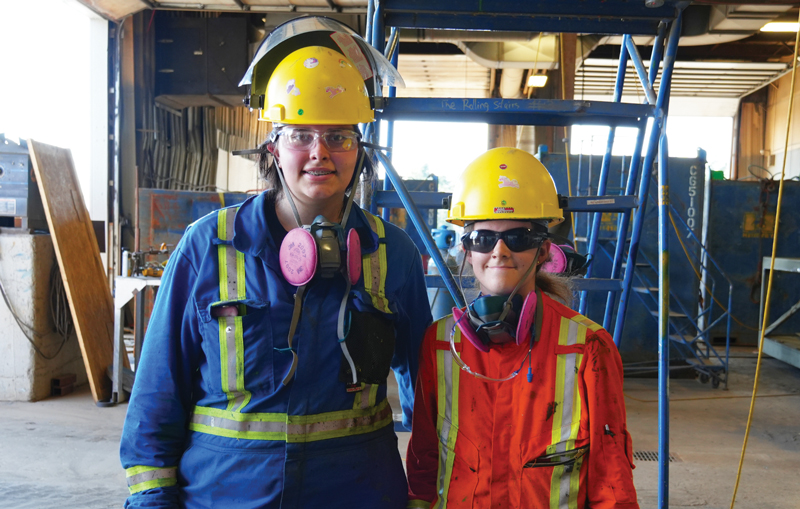
After years of working in construction, Abbott now has a better understanding of the industry. Living in Newfoundland was always important to him. But growing up, he saw many Newfoundlanders moving away to pursue trades or working turnarounds that meant living in another province most of the time. Now seeing firsthand that there’s a consistent need for skilled tradespeople in the province, he feels the career can be what you choose to make of it.
Working with your hands can also be very rewarding. Abbott shares that his first job was working on the Core Science Facility on Memorial University’s St. John’s campus. Having since walked through the finished building and seeing it as he drives through town, it brings a sense of pride. Passionate about promoting careers in skilled trades, Abbott works with Skills Canada Newfoundland and Labrador to get kids involved at an early age.
Skills Canada Newfoundland and Labrador is an organisation dedicated to helping youth discover career opportunities in technology and skilled trades. Its programming includes skilled trades and technology competitions, career exploration opportunities, school tours and entrepreneurship guidance.
In 2023, Skills Canada NL launched its Youth Apprenticeship Summer Program (YASP) across the province. The seven-week wage subsidy initiative helps high school students secure summer jobs in skilled trades. Joshua Ivany, Manager of the Youth Apprenticeship Summer Program, says the opportunity offers students early exposure to the construction industry and helps them determine if it’s a path they’d like to pursue long term. In addition to covering 75 per cent of a minimum wage salary, Skills Canada NL provides students with stipends for work equipment and professional development support.
The program was initially approved as a three-year pilot and has already been extended to 2028. In its first year, 12 students participated. Numbers more than tripled the following year, and in 2026, over 100 students are expected to secure summer placements in skilled trades through the initiative.

Early exposure will create curiosity that can be supported throughout secondary school and will encourage more students to consider trade programs and careers as options.
—Brent Howell, Dean of Natural Resources and Industrial Trades, College of the North Atlantic
Students can apply to YASP during grades 10 and 11 for placements in a variety of areas, including automotive, welding, electrical, carpentry, heavy-duty equipment mechanic, millwright and, new this year, power sport technician. Throughout the summer, students work a full-time schedule of 35 hours per week and shadow an experienced journey-person to learn their selected trade. No experience is required, and students partici-pate in real work. After the summer placement, some students continue working for their employer part-time throughout the school year.
Overall, YASP increases youth participation in skilled trades, provides students with industry contacts, and helps them accrue on-the-job training hours toward an apprenticeship. Completing the program also gives students two technology education credits towards high school graduation. After finishing high school, YASP students who choose to pursue a trade can also skip the mandatory nine-month pre-employment program. Overall, Ivany says the initiative exposes students to skilled trades and allows interested participants to enter the workforce sooner. “It keeps students on a fast track towards completing their apprenticeship. It’s a benefit for the students, employers and the province,” he commented.
While YASP is currently a summer work placement, Ivany says the ultimate goal is to expand it into a year-long opportunity integrated into the public education system, similar to youth apprenticeship programs currently available in other provinces.
Now living in Fort McMurray, Alberta, Samantha Avery says the school she chose for her son, Jay, was influenced by the opportunity for him to learn a trade at a young age. The province’s Registered Apprenticeship Program (RAP) is incorporated into the public school system. Students can apply after completing grade ten, which allows them to start working in skilled trades throughout the school year. In Jay’s case, he worked his placement as a millwright from September to February in grades 11 and 12, and completed core high school coursework for the remaining months of the academic year.
Avery says RAP helps students learn the responsibilities of becoming an adult. All participants complete 12-hour shiftwork like everyone else working in the field, and the paid apprenticeship is a chance for them to also learn financial responsibility. In addition to fast-tracking her son’s apprenticeship, Avery says the program has allowed him to learn from the best in the field and given him valuable contacts. Plus, he’s gained a sense of pride in his work. “When he came home from work, he’d tell us about the equipment he used that day and how he was praised for his work ethic. He was pretty proud of himself,” she commented.

While many programs focus on high school students, Brent Howell, Dean of Natural Resources and Industrial Trades at College of the North Atlantic, believes there’s a benefit to introducing youth to skilled trades even earlier. “Early exposure will create curiosity that can be supported throughout secondary school and will encourage more students to consider trade programs and careers as options,” he commented. He explains that many students make postsecondary plans before entering high school, which can affect course selection. So, engaging with students in junior high or before could help ensure the trades are considered early in a student’s decision-making process.
To attract more youth to careers in the construction industry, Howell says industry professionals could play a more active role. This can include collaborating with local colleges, visiting schools and initiating conversations with students. When colleges present program options or host student visits, industry professionals could be there to provide real-world insight. The industry should also support early apprenticeship initiatives and think creatively. Howell says industry-specific events that invite students to spend a day on-site could be especially effective. “Such exposure is often far more powerful than a presentation or brochure,” he commented.
Agreeing that youth should be introduced to skilled trades as early as possible, Valerie Penney feels that representation could also play a part. From her perspective, young people need to see someone who looks like them succeeding in the industry to consider it as a viable career option. While she feels it’s well ahead of where it used to be, the industry can always do better. She points to Initiatives like NLCA’s Women in Construction Professional Development Forum that show promise. Rather than just focusing on recruitment, the event encourages retention and career advancement, helping shape potential role models for the next generation.
Thinking about how to encourage a new wave of interest in skilled trades, Greg Abbott suggests a creative, hands-on approach. He describes activities used at Skills Canada NL events that engage youth. For example, to introduce kids to plumbing equipment, they can make hula hoops out of plumbing pipes. The activity gives kids a chance to actually use some tools as professionals explain how they’re used in practice, which sparks interest in a relatable and engaging way.
If young people are the future of Newfoundland and Labrador’s construction industry, it’s imperative to find new avenues towards building curiosity in skilled trades. Students like Jay Avery are a clear example of what’s possible, showcasing how early apprenticeship access can send youth on a fast track towards a strong career path. While these initiatives are making an appearance in Newfoundland and Labrador, collaboration between industry and a variety of stakeholders is key to scaling their impact. To ensure a sustainable future for the industry, the time to act is now.
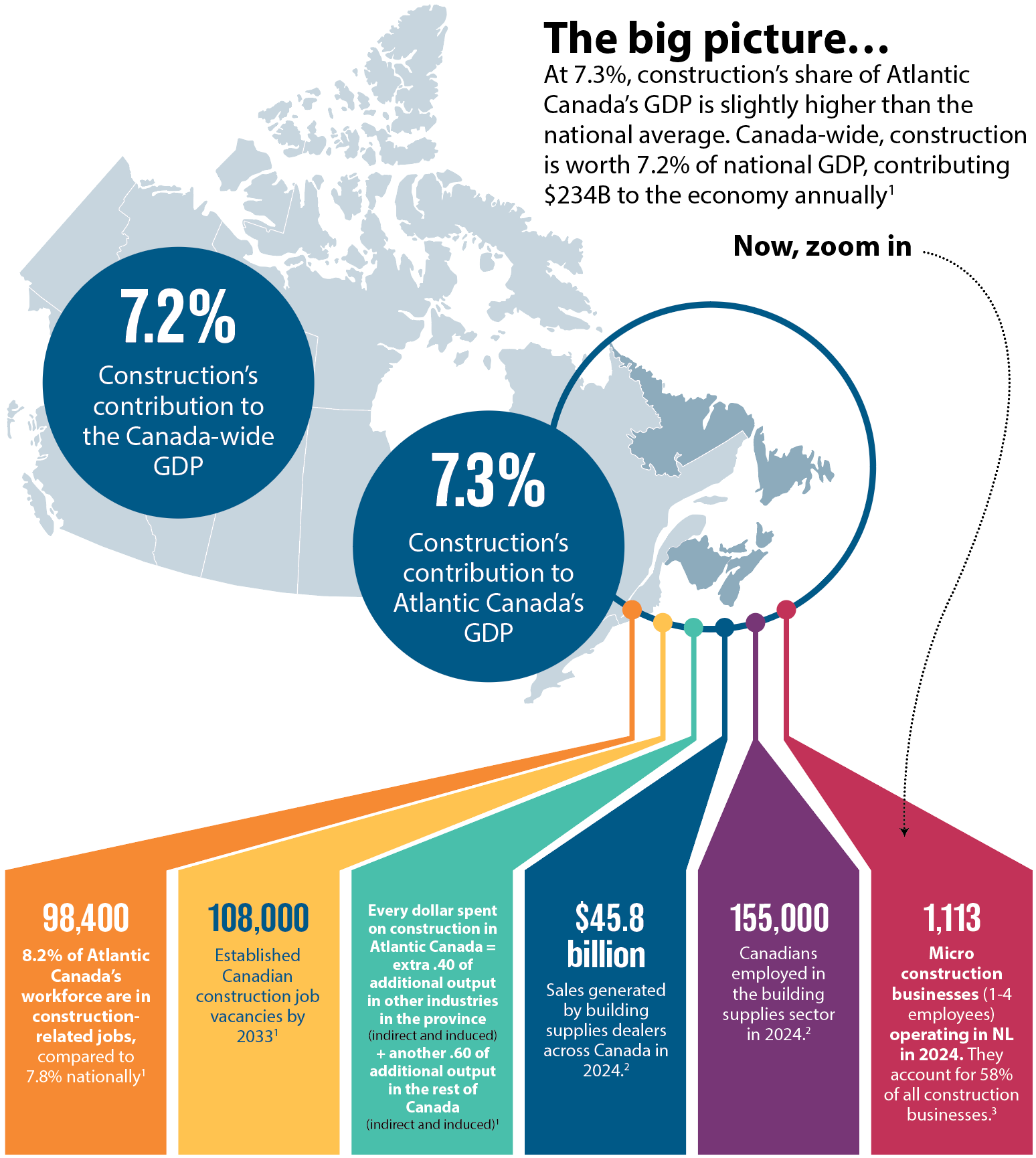
When it comes to economic impact and cross-sectional multipliers, construction delivers
Comment policy
Comments are moderated to ensure thoughtful and respectful conversations. First and last names will appear with each submission; anonymous comments and pseudonyms will not be permitted.
By submitting a comment, you accept that Atlantic Business Magazine has the right to reproduce and publish that comment in whole or in part, in any manner it chooses. Publication of a comment does not constitute endorsement of that comment. We reserve the right to close comments at any time.
Cancel