Account Login
Don't have an account? Create One
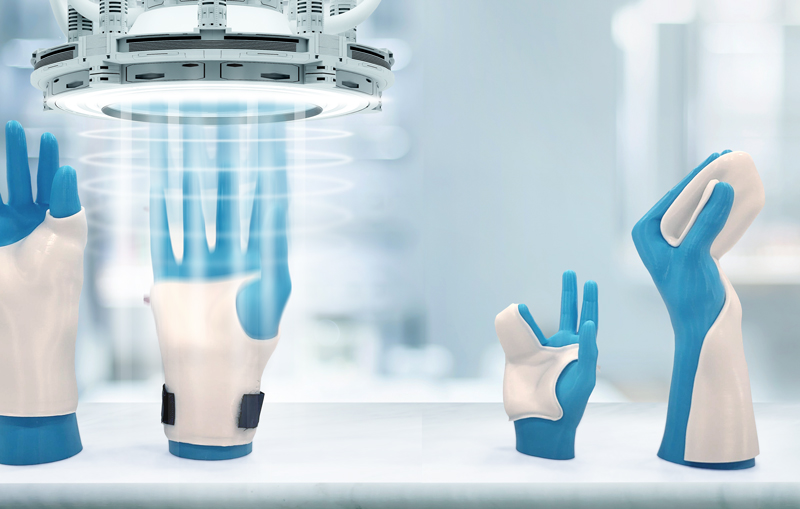
It’s not the Starfleet replicator, but PolyUnity’s i3D Health is the next best thing: a St. John’s-built platform that lets health systems across Canada print custom medical devices on demand, in a fraction of the time and at a fraction of the cost.
If NASA astronauts can do it in orbit, why can’t we do it in Newfoundland and Labrador?
That question lit a fire under three Memorial University medical students—Stephen Ryan, Michael Bartellas and Travis Pickett—to use existing technology to revolutionize health care delivery.
Their dream in 2018: to improve access to timely health care in remote regions of Newfoundland and Labrador through 3D printing. Their reality in 2026: PolyUnity, a Health Canada-licensed, ISO-certified provider of what the industry calls additive manufacturing as a service (AMaaS), or 3D printing on demand, with a digital catalogue of more than 500 products. Its printers in Atlantic Canada, Ontario and British Columbia serve thousands of clinicians and patients in nine provinces and one territory.
Along the way, the founders have learned what every health-tech entrepreneur eventually does: inventing the technology is the easy part. Selling it into public health care, with its regulators, procurement rules and many stakeholders, takes far longer. That PolyUnity has managed it anyway, going from a dining room table to contracts with health systems from coast to coast, is what sets it apart.
It was Ryan who had seen a video of astronauts aboard the International Space Station 3D printing a tool they needed, using a design emailed from a desk some 400 kilometres below on Earth. He pitched a research idea to MUN’s Faculty of Medicine: study the potential for 3D printing in N.L. health care delivery. Bartellas and Pickett joined the research team and, with faculty support, they secured a $25,000 grant for a project called MUN Med3D.
Continue reading this story: click below to login/subscribe
Login or SubscribeComment policy
Comments are moderated to ensure thoughtful and respectful conversations. First and last names will appear with each submission; anonymous comments and pseudonyms will not be permitted.
By submitting a comment, you accept that Atlantic Business Magazine has the right to reproduce and publish that comment in whole or in part, in any manner it chooses. Publication of a comment does not constitute endorsement of that comment. We reserve the right to close comments at any time.
Cancel