Account Login
Don't have an account? Create One
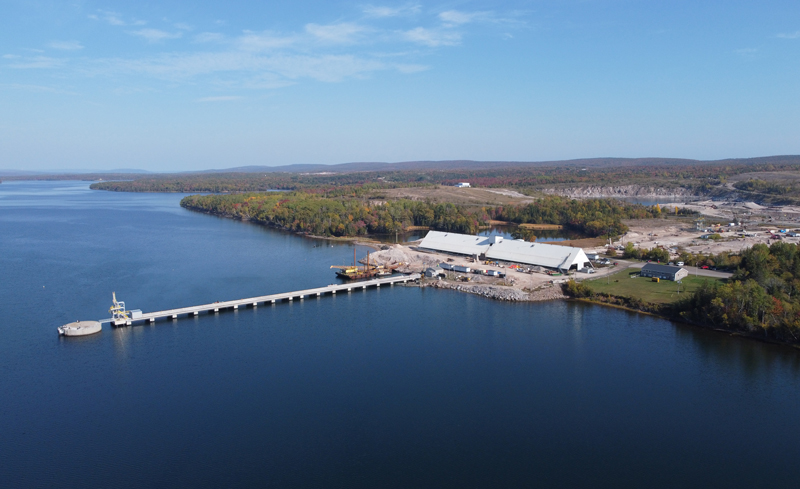
The Canadian Gypsum Company, CGC Inc., is well on its way to re-starting its storied quarry in Nova Scotia, expected in 2026. But, president Steve Youngblut recently suggested to Atlantic Business Magazine, the industry’s capacity to rapidly increase production of supplies like drywall is going to need a lot more attention if Canada wants to meet its construction and home building aspirations. For now, he suggested, the industry is doing what it can.
CGC traces its roots back more than a century. It boasts several mining operations, feeding 15 manufacturing and related facilities. The company has a healthy list of products but focuses mainly on mining gypsum, and manufacturing drywall and related products (compounds, fillers, tape). Its parent company, U.S.-based USG, is in turn part of the German-owned Knauf Group of Companies.
CGC began operating a gypsum quarry at a site known as Little Narrows, on Cape Breton, N.S., back in 1954. It continued to operate there until 2016.
According to Youngblut, synthetic gypsum—a byproduct of coal power plants—“became very popular and very cost-effective,” and progressively more present in North America at the time. The emergence started, he estimated, in the late 1990s, increasing through the 2000s. It played a significant role in the fate of many gypsum quarries, not just Little Narrows. Some uncertainty in U.S. home builds was also believed to have played into the decision to shut down.
More recently, however, quarried gypsum is seeing a resurgence. “Because of environmental reasons, we’ve been seeing these (coal) power plants across North America being shut down one by one,” explained Youngblut.
A number of manufacturing facilities have now been converted back to use of natural rock. That includes CGC facilities in the U.S., and one in Montreal.
In 2023, with the landscape shifting, CGC announced its plan to re-start the quarry at Little Narrows at an estimated cost of US$104 million. Youngblut told Atlantic Business Magazine that work to reopen the site is ongoing, with a new dock completed for shipments, new conveyer systems, new buildings for storage, maintenance, employee change rooms all complete. Though there is still work to be done, hiring is ongoing for the approximately 100 jobs associated with the renewed operation.
“Our goal is to have this place completely operational by September 2026,” he said.
Once running, the site will provide gypsum to six CGC manufacturing facilities, including Montreal and stretching as far south as Jacksonville, Florida.

Looking at CGC’s broader operations as part of the supply chain for Canadian home builders, there have been some unique challenges over the past decade. A main factor is supplying Canadian demand for wall board, an issue that can be traced back, according to Youngblut, to a dispute around pricing for product crossing the Canada-U.S. border.
In 2015, a complaint from another Canadian supplier in Western Canada was filed with trade authorities. It eventually led to anti-dumping tariffs at the border, including—as the Canadian press reported in 2016—a preliminary tariff of up to 276 per cent on gypsum board products coming from the U.S. into Canada.
Drywall prices quickly shot up for Canadian contractors. There were reports of imported product being priced too high to work for existing contracts; production in Western Canadian facilities wasn’t enough to serve domestic needs.
CGC, meanwhile, had been supplying Western Canada in part from a plant it had built in Ranier, Washington. It was designed for half of its production to serve the Canadian market and half for the U.S. The trade rulings and tariffs quickly killed that idea, as Youngblut said what was being moved by the company into Canada, couldn’t “be anywhere near cost competitive.”
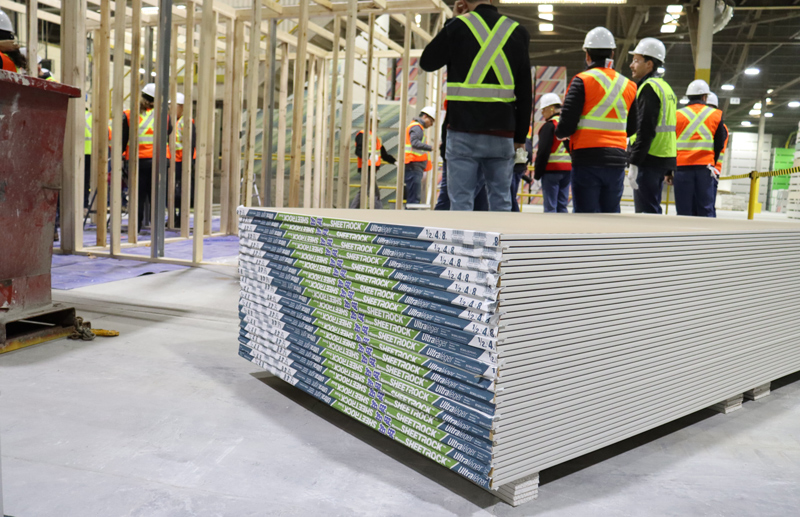
He said CGC worked to deliver in a rather nightmarish situation, re-allocating resources from Eastern Canada to make things work. “We have been shipping up to 3,000 rail cars from Nova Scotia or Ontario into the Western Canadian provinces,” he said. That was initially on and off, and then consistently since about 2018.
“Some of (our customers), we had to walk away from. Some of them, their lead times were extended to seven to eight times what they normally were, but overall a tremendous amount of strain right across Canada,” Youngblut said. He believes the drywall shortage played a major role in limiting new home completions in Canada.
Improvements, however, are in the works. CGC approved capital investment for a new Western Canadian manufacturing facility around the same time the company was settling plans for Little Narrows. Being built near Strathmore, Alberta, it has a projected production capacity of 4 million square feet of wallboard each year. That’s enough for about 50,000 homes.
While the Strathmore facility will allow some additional capacity in Canada on drywall production, Youngblut said the facility costs about $220 million to construct and the country will need more, new facilities to hit the construction goals governments are describing.
“To see a whole bunch of investment like that across our industry, to that level, would be challenging for sure,” he said, suggesting some companies may need to form new partnerships to help increase production.
In the meantime, CGC is looking forward to celebrating its fresh start at Little Narrows. “There’s other things for the province too that we haven’t announced yet, but I think will be really exciting for the future as well,” he said.
Atlantic Business Magazine will have more related to housing in Atlantic Canada in its first print issue of the new year, available Jan. 1.
Similar articles:
Comment policy
Comments are moderated to ensure thoughtful and respectful conversations. First and last names will appear with each submission; anonymous comments and pseudonyms will not be permitted.
By submitting a comment, you accept that Atlantic Business Magazine has the right to reproduce and publish that comment in whole or in part, in any manner it chooses. Publication of a comment does not constitute endorsement of that comment. We reserve the right to close comments at any time.
Cancel