Account Login
Don't have an account? Create One
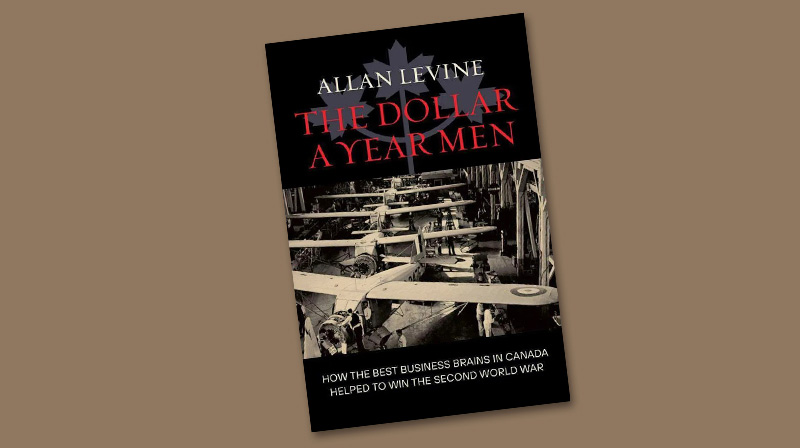
Historian and author Allan Levine has given a lot of thought to the idea of Canada undertaking an industrialization effort equivalent to what it did during WWII. Having researched exactly what it took to achieve back then, he told Atlantic Business Magazine he would be very surprised if it could happen again at this point in history. Frankly, he doesn’t see it being possible.
Levine’s book The Dollar a Year Men: How the Best Business Brains in Canada Helped to Win the Second World War is now available and offers powerful insights into the attitudes and personalities involved in some of the most extraordinary moments in Canadian business history. He reveals some of the motivations and sacrifices for both corporations and individuals, including business leaders from the Maritimes, who played key roles in Canada’s flurry of wartime industrial activity.
There’s no denying the scale and speed of what was involved. The statistics on industrial production in Canada during WWII are, as Levine rightly puts it, “nothing short of amazing”.
From the War Supply Board under Finance Minister J.L. Ralston to the replacement Department of Munitions and Supply launched in 1940, reporting to star minister C.D. Howe, Levine focuses his book on the so-called “dollar-a-year men”. These were typically industrialists and entrepreneurs, several from the Maritimes, recruited to come to Ottawa.
“Dollar-a-year men, some of these guys were involved with this for three or four years. They left their companies and essentially re-located to Ottawa for five days a week and left their companies and clients in the hands of other people,” he told Atlantic Business Magazine.
Their collective nickname started in the U.S. during WWI, with the dollar being a symbolic salary. In Canada, rather than having a dollar paid each year from the Canadian government (Levine found only one in the cohort was ever issued the dollar), they were covered for expenses like room, board and travel. Most notably, their home companies issued allowances. In some cases, the men continued to receive their regular, executive pay.
“But that was a form of patriotism too, because some of the companies certainly didn’t need to do that. And I think they would have different attitudes about that today,” he suggested.

They weren’t given a blank cheque, but it wasn’t business as usual either. Howe worked politically to clear a path for the men, who did not just create a few factories or handful of products. In short order, they developed whole new Crown corporations, raised entire branches of interwoven manufacturing companies for their respective needs (artillery, transit, weaponry), with the addition of unprecedented activity in R&D. They assumed, seized, acquired and built as needed, not without controls but largely flatly supported instead, while the government paid.
“I just couldn’t contemplate something like that happening today,” Levine said.
He highlights Halifax businessman Ralph Bell, one of the director generals. Bell had first met Howe while on a vacation more than a decade prior to being called to Howe’s office. Howe asked him to oversee aircraft production needed for the war effort. Levine recounts how Bell responded by saying he personally knew how to fly small planes but not how to build them. Still, he ultimately accepted an appointment as Canada’s director general of aircraft production.
Levine offers up extraordinary bits of Bell’s personal history from his time growing up in Halifax, into early business experiences that shaped his “hard-nosed, take-no-prisoners personality.”
Just prior to the war, Bell had been active in wholesale distribution and shipping. In getting Canada up and running as a major supplier of military aircraft, he worked closely with men around him including fellow dollar-a-year man James Stuart Duncan, who had a mind for machinery.
Bell dismissed any criticisms in the mass media as he re-tooled existing factories or, when the space wasn’t apparent, saw new factories and workshops built. He fought with unions—critical of workers in a way unlikely to be accepted in the modern day—and he even fought occasionally with Howe.
“I knew nothing about Ralph Bell before I did this project and he turned out to be a really interesting guy (…) I mean he turned out to be a bit of a tough nut and not a very nice person to work with sometimes. And I think I read somewhere that even his children would have admitted that, that he had sort of a harsh side to him,”
—Allan Levine
“I knew nothing about Ralph Bell before I did this project and he turned out to be a really interesting guy (…) I mean he turned out to be a bit of a tough nut and not a very nice person to work with sometimes. And I think I read somewhere that even his children would have admitted that, that he had sort of a harsh side to him,” Levine said.
He described the dollar-a-year men, collectively, as “men of the era”.
Their extraordinary stories are often tied directly to the unusual orders they were managing at any given time and the circumstances of the day. Levine suggested alterations to budgeting, application of things like the War Measures Act, and resistance to any talk of conflict of interest involving the industrialists all played a role in the history.
“Our attitudes about this kind of stuff… I think we’re much more critical about it. We’d be—and the government (Opposition) would, given the news cycle and social media—be all over some of this stuff,” he said.
Still, for all their flaws and challenges, as he shows, they served their mandates as best they could, and to some obvious successes. “In 1939, there were eight small aircraft plants that employed approximately 4,000 workers and produced about 40 airplanes a year in a total of 500,000 square feet of factory space,” Levine writes at one point, emphasizing pre-war aircraft producers were overall poorly equipped and reliant on a handful of service and supply companies.
Then came Howe, Bell and the other dollar-a-year cohort. “By 1944, the industry employed more than 116,000 people (…) They manufactured more than 4,000 planes annually in 15 million square feet of factory space,” he writes. The Canadians ultimately made more than 16,000 planes for the Allied forces.
Wartime manufacturing has seen some attention from researchers and historians in the past, but Levine said he was interested in a readable, dedicated treatment. He hunted out those pieces of information that would bring out more on the humans behind the business. He makes reference to earlier publications, like Toronto-based historians William Kilbourn (d. 1995) and Robert Bothwell’s biography of C.D. Howe. Levine also foraged for new materials, gaining access to everything from a 2013 Masters thesis by then-University of Calgary student Jeremy Stuart (who then consulted with Levine), to an unpublished biography made for a dollar-a-year man’s family. There is material from Munitions and Supply papers at Library and Archives Canada, but also information from smaller repositories providing details on Atlantic Canadian involvement, including the Mount Allison University Archives. Significantly, Levine sought out interviews with still-living former colleagues or family relations of the men, for example two of the grandchildren of General Motors of Canada VP Harry Carmichael (d. 1979).
“Some of them didn’t talk about (their war work) much with their families even later on,” Levine told Atlantic Business Magazine, adding memoirs could also often gloss over wartime experiences. “Some of them were WWI veterans. They definitely sacrificed. They made a sacrifice of their time (…), they didn’t see their kids and living and working 80 hours a week. It’s pretty impressive. No one forced them to do it, other than Howe could be very convincing. But still, they could have said no,” he said. “As far as I can tell, hardly anybody ever said no.”
Related stories
In Book Report, Atlantic Business Magazine highlights non-fiction focused on Atlantic Canada and Atlantic Canadians, and from Atlantic Canadian publishers. These short pieces offer details from upcoming business biographies, Q&As on new releases and in some cases fresh commentary from non-fiction authors on the subjects of their published works.
Comment policy
Comments are moderated to ensure thoughtful and respectful conversations. First and last names will appear with each submission; anonymous comments and pseudonyms will not be permitted.
By submitting a comment, you accept that Atlantic Business Magazine has the right to reproduce and publish that comment in whole or in part, in any manner it chooses. Publication of a comment does not constitute endorsement of that comment. We reserve the right to close comments at any time.
Cancel