Account Login
Don't have an account? Create One
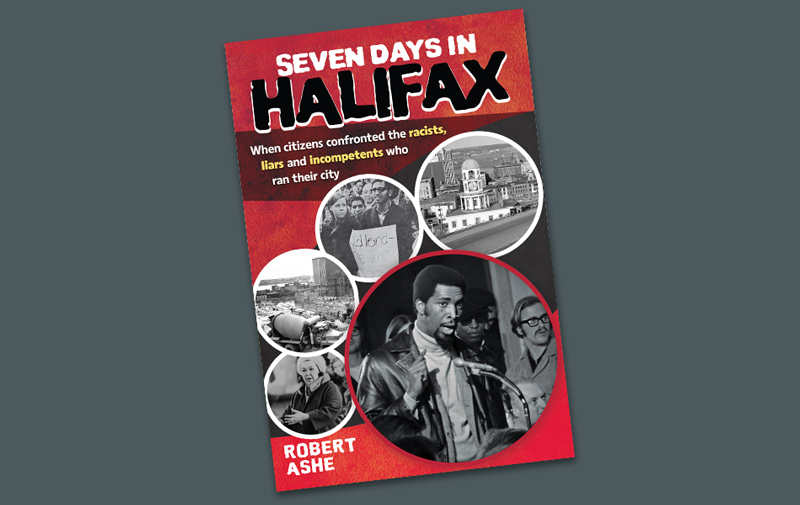
In 1970, Volvo Canada staff offered a tour of their Halifax assembly plant to Canadian and American panelists taking part in the Encounter on Urban Environment. That was the formal name of a series of unique consultations and public town hall events, exploring issues facing the City of Halifax. Topics included things like housing and transportation but extended into regional economics and ultimately social justice, with transformative moments for some of the biggest names in local business.
Following the tour—recounted by author Robert Ashe in his new book Seven Days in Halifax—there was discussion of staffing at the car plant. A simple statement from Civil Rights activist Rev. Lucius Walker to the car maker’s local personnel manager Ed Hanse became a watershed moment for Volvo and other major employers.
“You just gave us a general profile of the men in the shop. I observed no non-white persons in the shop. And I wonder if there’s any significance to this, or does it reflect any applicant practice or hiring policies?” Walker asked, in what Ashe describes as “the Volvo moment.”
Walker was a 38-year-old Baptist minister, director of the Interreligious Foundation for Community Organizations in New York City, and one of seven Americans invited onto the 12-person panel questioning the ins and outs of life and work in the city.
Hanse’s response, according to Ashe, described the local manufacturing site, which then produced 8,000 cars a year, as “equal opportunity.” He said they received at least 1,000 applicants a year for openings, though admittedly with a common profile. “I can’t remember when the last Negro even came looking for a job,” he said.
As Ashe details, criticism and commentary emerged during the following week which led to further reflection on why more Black people were not applying. “The Volvo thing was a real embarrassment to the company, which had a really good image up to that time. Everybody was trying to get a job at Volvo,” said Ashe, who resided in Halifax at the time of the events.

“To their credit, (Volvo) responded really quickly. (…) They knew they had to come up with some sort of response. And then the head office said this is unacceptable. Get over here, you need to turn this controversy around. And they did. Because they were good corporate citizens generally speaking,” he told Atlantic Business.
But it all started with a tour and a single comment, in the midst of what became commonly known as “Encounter”.
As Ashe writes, the car maker wasn’t the only company to face criticisms during the Encounter forums. In addition to the panel’s day-time tours and private meetings, there were live broadcasts of evening town hall events. The sometimes fiery exchanges included comments related to public investments in the name of job creation and corporate responsibility to the local community.
In a session focused on Crown corporation Industrial Estates Limited (IEL), Ashe said IEL was taken to task for its productivity by the panel. The panel challenged the effectiveness of IEL’s investments and usefulness of the corporation overall.
The value of the sessions, Ashe says, was in allowing the community to confront itself in different ways. In a recent interview, Ashe credited the Conservative-dominated leadership of the day with being willing to invite in progressive panelists and open themselves up to scrutiny.
Ashe came across a reference to Encounter during research for another book. In that moment, he recalled the live broadcasts from his childhood and decided to chase down whatever records he could, sparking years of work for this book.
It would be hard to capture that level of public attention and engagement today, in terms of there being so many more channels of public media and a far less concentrated audience. Ashe is also not sure today’s politicians and business leaders, in what he describes as a liberal-progressive city, would be willing to open themselves up to the kind of scrutiny the Encounter events produced more than half a century ago.
“They would probably not be comfortable bringing in a number of conservative panelists, for example. So, I think for that reason it is unlikely to happen in an open and very useful and explosive way, as it did back then. But is it still worth doing? Absolutely,” he said.
Related stories
In Book Report, Atlantic Business Magazine highlights non-fiction focused on Atlantic Canada and Atlantic Canadians, and from Atlantic Canadian publishers. These short pieces offer details from upcoming business biographies, Q&As on new releases and in some cases fresh commentary from non-fiction authors on the subjects of their published works.
Comment policy
Comments are moderated to ensure thoughtful and respectful conversations. First and last names will appear with each submission; anonymous comments and pseudonyms will not be permitted.
By submitting a comment, you accept that Atlantic Business Magazine has the right to reproduce and publish that comment in whole or in part, in any manner it chooses. Publication of a comment does not constitute endorsement of that comment. We reserve the right to close comments at any time.
Cancel