Account Login
Don't have an account? Create One
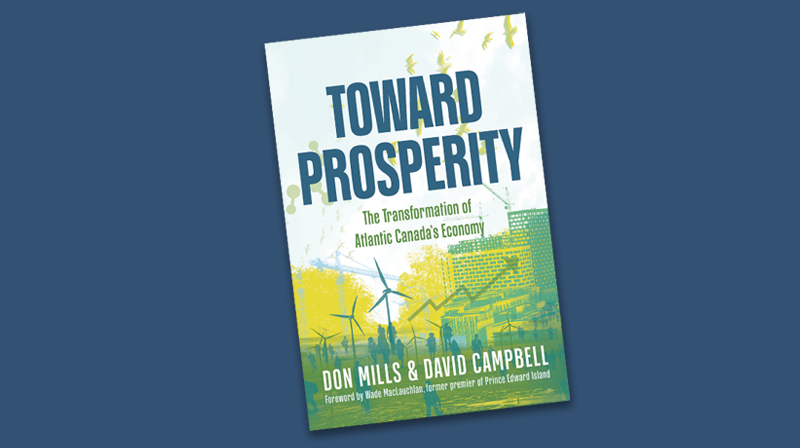
The Atlantic Canadian economy is full of exciting business stories but needs more concerted efforts by business leads and associations for continued growth and a truly prosperous region. That’s according to Don Mills and David Campbell. The social scientist and economist, respectively, are a tag-team already known for their individual work and joint Insights podcast. Earlier this year, the co-authors released Toward Prosperity: The Transformation of Atlantic Canada’s Economy.
With extensive use of gathered data, the text runs through headline challenges, including Atlantic Canada’s aging population, immigration needs and rural development hurdles. In three main sections, the authors break down historic economic underperformance, positive changes and new hurdles for business, and then offer their “prescription for future prosperity.”
They cheer a wave of ambitious governments. In separate interviews about the book, each mentioned Nova Scotia Premier Tim Houston’s push for the “Wind West” energy plan as an example.
“We finally seem to have ambition at the political level to go for it instead of being cautious and doing incremental things. We’re focused on the big, transformational things,” Mills told Atlantic Business Magazine.
At the same time, the authors condemn what they describe as a default dependency of individuals and businesses on government money and actions.
At one point, while describing the idea of living in a rural area with expectations of access to the same level of services as in the city, Mills writes of a “culture of entitlement and resistance to change.” He told Atlantic Business Magazine it’s different from the condemnation in the “culture of defeatism” descriptor used in 2002 by former prime minister Stephen Harper.
“We need a wake-up call. Our dependency on government overall is very high in this region and it’s actually stalled our economic development,” he said.
The book makes a clearer call for more ambition from business owners and senior business leadership, such as pushing sales beyond local markets. Both Mills and Campbell say it’s about more businesses seizing existing opportunities but also new ones coming ashore (or found offshore) in advanced technology, critical minerals, federal Defence spending and energy production.
“I believe very firmly these organizations need to evolve from just straight lobby organizations to helping government understand workforce supply and demand in their specific industries and how we can address those specific issues,”
—David Campbell
In the world of natural resource development, the pair stress the idea of dealing with “NIMBYism” they see arising in response to business proposals, whether in relation to fish farms for aquaculture or windmills for electricity from the offshore.
“We need to address the attitudinal challenges that have been preventing us from building things in our region,” Mills said.
Campbell said he’d personally like to see industry associations in the region—all of them—doing more to quantify and otherwise detail sectoral needs. Some associations have put in the money and effort to periodically offer up real numbers and actionable information. However, he suggested, many have not.
“I believe very firmly these organizations need to evolve from just straight lobby organizations to helping government understand workforce supply and demand in their specific industries and how we can address those specific issues,” he said.
Governments are at the table with business and there will always be individual lobby efforts but, he said, it’s really up to the industry associations and chambers of commerce to assure there’s a proper environment for overall growth of industries.
In addition to challenges like the aging population, he suggested the old days of relying on a low-cost business model—leaning into the idea of cheaper, local labour to win out against Central and Western-Canadian competition for instance—is going to the wayside. After decades of working on closing the wage gap versus other provinces, Atlantic Canada now has to increasingly work on cost competition and the related issues of productivity. It’s not isolated to sectors like resource extraction and manufacturing but includes service businesses. For example, the region’s legal, accounting and engineering firms are poised for tougher fights for contracts as barriers to doing business across Canada continue to fall.
“At the end of the day we need industry to make major investments to increase their productivity so that they can compete,” Campbell said.
It would be easy to think it’s all a re-hashing of the same ol’ on economic development and nothing really changes for Atlantic Canada. Mills pointed out there’s already an argument to the contrary. He noted the book highlights the importance of interprovincial trade, which has been changing in recent months thanks to coordinated efforts to reduce trade barriers.
“When we wrote that, we actually didn’t think we’d see it in our lifetime,” he said, as he advocated for continued ambition, increased collaboration and a more prosperous future.
With the use of quantitative data, from sources like the federal Department of Finance and Statistics Canada from the 1980s into the 2020s, Toward Prosperity offers both a base and jumping off point for all manner of discussions around business supports and spurring economic development.
Related stories
In Book Report, Atlantic Business Magazine highlights non-fiction focused on Atlantic Canada and Atlantic Canadians, and from Atlantic Canadian publishers. These short pieces offer details from upcoming business biographies, Q&As on new releases and in some cases fresh commentary from non-fiction authors on the subjects of their published works.
Comment policy
Comments are moderated to ensure thoughtful and respectful conversations. First and last names will appear with each submission; anonymous comments and pseudonyms will not be permitted.
By submitting a comment, you accept that Atlantic Business Magazine has the right to reproduce and publish that comment in whole or in part, in any manner it chooses. Publication of a comment does not constitute endorsement of that comment. We reserve the right to close comments at any time.
Cancel
thanks for info.