Account Login
Don't have an account? Create One

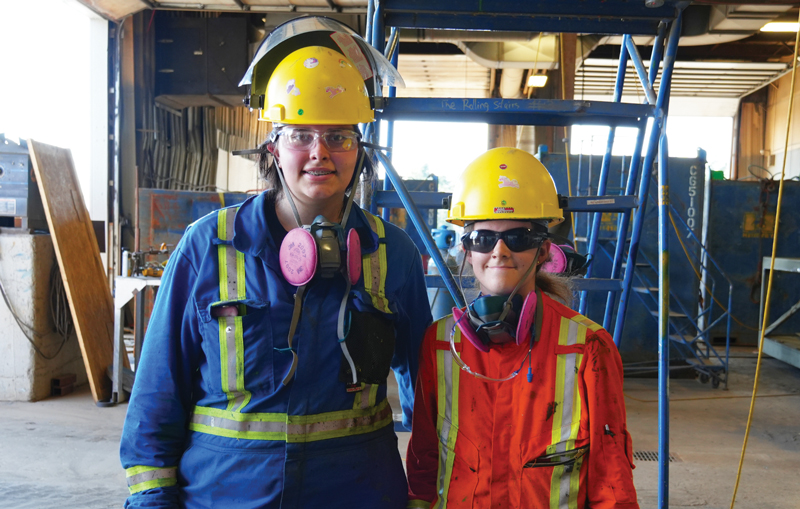
As a seventeen-year-old in the eleventh grade, Jay Avery started his day by catching a bus at 6 a.m., headed to the Aurora Mine Site near Fort McMurray, Alberta. There, he was training as a millwright, working with some of the largest mining equipment in the world. After finishing his 12-hour shift, he returned home and prepared for the next workday. He followed this schedule for about six months, working six days on and six days off. Avery then completed a semester of core high school coursework before returning to work the following September to start his senior year.
Now, at 18 years old, Jay is a few months away from graduating high school with hundreds of accumulated training hours for his trade and is well on his way towards a promising career.
Stories like Jay’s are an example of what’s possible when youth are given the right opportunities. The future of Newfoundland and Labrador’s construction industry workforce is uncertain. And the next generation is the answer.
According to projections from BuildForce Canada, an organisation dedicated to studying and supporting the construction industry labour force, up to 8,300 workers will have to be recruited by 2034 in Newfoundland and Labrador. This number accounts for an overall increase in labour requirements, as well as nearly 30 per cent of the province’s current construction industry workforce retiring over the next eight years. BuildForce estimates that local talent entering the sector will currently meet about 54 per cent of labour requirements. However, this leaves a gap of about 3,800 trades-people. Looking ahead, attracting more young people to careers in construction will be critical to strengthening the industry’s talent pipeline.

Valerie Penney, Senior Project Manager at rcs Construction and Chair of the Newfoundland and Labrador Construction Association, has been working in the industry for about 20 years and agrees that workforce capacity is an issue. Consistent with BuildForce Canada’s findings, Penney sees firsthand that many tradespeople in the province are nearing retirement and fewer young people are pursuing careers in the sector. As an organisation, the NLCA is currently focused on advocating to change this trend and encourage more young students to consider working in construction.
While this challenge exists nationally, Penney says it can be more pronounced in N.L., given its ageing population and the tendency for young workers to leave the province for trade opportunities elsewhere. Once people move away, it’s harder to get them back.
Penney believes that the time to act is now. We must grow the number of experienced tradespeople in the province before the labour gap becomes an even larger problem years down the road. It’s also crucial to take advantage of the mentorship and knowledge-sharing opportunities between new apprentices and skilled industry professionals who are soon ready to retire. Encouraging youth to enter the sector early gives them time to gain experience and grow into the next generation of leaders.
When it comes to how young students are introduced to careers in the construction industry, Penney says exposure remains the biggest gap. These days, many don’t even consider pursuing skilled trade apprenticeships. Penney says her background ensures her children are familiar with work opportunities in construction, but many parents she’s spoken with say their kids nearing high school graduation don’t even know what the trades are. At that age, there’s a lot of pressure for high school students to choose what they want to do for the rest of their lives. But many don’t understand the full range of career choices available. For many students, university is still considered the best, and often expected, path to future success. But, as Penney points out, it isn’t the right fit for everyone. “We need to support and promote skilled trade apprenticeships as equal to university pathways,” commented Penney. She explains that unless students have family who work in construction, many don’t have the exposure needed to know what a career in the industry can look like.

We need to support and promote skilled trade apprenticeships as equal to university pathways.
—Valerie Penney, Senior Project Manager, rsc Construction 2026-27, NLCA Board Chair
There are many misconceptions about working in construction. Penney says it can be considered an unstable industry, with low-tech jobs that have limited growth potential. But the reality is quite the opposite. While the industry experiences its share of highs and lows, there is a consistent need for skilled labour in the province. Careers in the field offer a wide range of paths and are increasingly innovative, technology-driven and well-paying. Penney explains that there are also plenty of leadership opportunities. A career in the trades doesn’t have to mean working hands-on with tools long term. In fact, Penney notes that in her experience, some of the best leaders started out as labourers. Presenting an accurate picture of working in the industry and the available opportunities can go a long way to having more young students consider working in construction.
Having taken an unconventional path into the industry, Greg Abbott can relate to the uncertainty of choosing a career at a young age. Upon graduating from high school, Abbott applied to both engineering and music programs at university. After completing two years of a music degree, he decided to pivot and move to Ontario to study sports management. Realising that a lack of job opportunities in the field would make it difficult to return to his home province, he then made another change. Ultimately, Abbott moved back to Newfoundland to pursue a trade. Now a Journeyman Red Seal Plumber of three years, he says if he had known years ago what he knows now, he probably would have considered a trade sooner.
While he was aware of skilled trades at a young age, Abbott says it never seemed like a viable career choice. He remembers enjoying an elective on the subject in high school, but with his high grades, teachers always encouraged him to pursue a university degree in engineering rather than an apprenticeship. Abbott feels there is a perceived notion that university degrees are superior, but he doesn’t agree. “A trade is just another career path that shouldn’t be looked at differently than any other,” he commented.
After years of working in construction, Abbott now has a better understanding of the industry. Living in Newfoundland was always important to him. But growing up, he saw many Newfoundlanders moving away to pursue trades or working turnarounds that meant living in another province most of the time. Now seeing firsthand that there’s a consistent need for skilled tradespeople in the province, he feels the career can be what you choose to make of it.
Working with your hands can also be very rewarding. Abbott shares that his first job was working on the Core Science Facility on Memorial University’s St. John’s campus. Having since walked through the finished building and seeing it as he drives through town, it brings a sense of pride. Passionate about promoting careers in skilled trades, Abbott works with Skills Canada Newfoundland and Labrador to get kids involved at an early age.
Skills Canada Newfoundland and Labrador is an organisation dedicated to helping youth discover career opportunities in technology and skilled trades. Its programming includes skilled trades and technology competitions, career exploration opportunities, school tours and entrepreneurship guidance.
In 2023, Skills Canada NL launched its Youth Apprenticeship Summer Program (YASP) across the province. The seven-week wage subsidy initiative helps high school students secure summer jobs in skilled trades. Joshua Ivany, Manager of the Youth Apprenticeship Summer Program, says the opportunity offers students early exposure to the construction industry and helps them determine if it’s a path they’d like to pursue long term. In addition to covering 75 per cent of a minimum wage salary, Skills Canada NL provides students with stipends for work equipment and professional development support.
The program was initially approved as a three-year pilot and has already been extended to 2028. In its first year, 12 students participated. Numbers more than tripled the following year, and in 2026, over 100 students are expected to secure summer placements in skilled trades through the initiative.

Early exposure will create curiosity that can be supported throughout secondary school and will encourage more students to consider trade programs and careers as options.
—Brent Howell, Dean of Natural Resources and Industrial Trades, College of the North Atlantic
Students can apply to YASP during grades 10 and 11 for placements in a variety of areas, including automotive, welding, electrical, carpentry, heavy-duty equipment mechanic, millwright and, new this year, power sport technician. Throughout the summer, students work a full-time schedule of 35 hours per week and shadow an experienced journey-person to learn their selected trade. No experience is required, and students partici-pate in real work. After the summer placement, some students continue working for their employer part-time throughout the school year.
Overall, YASP increases youth participation in skilled trades, provides students with industry contacts, and helps them accrue on-the-job training hours toward an apprenticeship. Completing the program also gives students two technology education credits towards high school graduation. After finishing high school, YASP students who choose to pursue a trade can also skip the mandatory nine-month pre-employment program. Overall, Ivany says the initiative exposes students to skilled trades and allows interested participants to enter the workforce sooner. “It keeps students on a fast track towards completing their apprenticeship. It’s a benefit for the students, employers and the province,” he commented.
While YASP is currently a summer work placement, Ivany says the ultimate goal is to expand it into a year-long opportunity integrated into the public education system, similar to youth apprenticeship programs currently available in other provinces.
Now living in Fort McMurray, Alberta, Samantha Avery says the school she chose for her son, Jay, was influenced by the opportunity for him to learn a trade at a young age. The province’s Registered Apprenticeship Program (RAP) is incorporated into the public school system. Students can apply after completing grade ten, which allows them to start working in skilled trades throughout the school year. In Jay’s case, he worked his placement as a millwright from September to February in grades 11 and 12, and completed core high school coursework for the remaining months of the academic year.
Avery says RAP helps students learn the responsibilities of becoming an adult. All participants complete 12-hour shiftwork like everyone else working in the field, and the paid apprenticeship is a chance for them to also learn financial responsibility. In addition to fast-tracking her son’s apprenticeship, Avery says the program has allowed him to learn from the best in the field and given him valuable contacts. Plus, he’s gained a sense of pride in his work. “When he came home from work, he’d tell us about the equipment he used that day and how he was praised for his work ethic. He was pretty proud of himself,” she commented.

While many programs focus on high school students, Brent Howell, Dean of Natural Resources and Industrial Trades at College of the North Atlantic, believes there’s a benefit to introducing youth to skilled trades even earlier. “Early exposure will create curiosity that can be supported throughout secondary school and will encourage more students to consider trade programs and careers as options,” he commented. He explains that many students make postsecondary plans before entering high school, which can affect course selection. So, engaging with students in junior high or before could help ensure the trades are considered early in a student’s decision-making process.
To attract more youth to careers in the construction industry, Howell says industry professionals could play a more active role. This can include collaborating with local colleges, visiting schools and initiating conversations with students. When colleges present program options or host student visits, industry professionals could be there to provide real-world insight. The industry should also support early apprenticeship initiatives and think creatively. Howell says industry-specific events that invite students to spend a day on-site could be especially effective. “Such exposure is often far more powerful than a presentation or brochure,” he commented.
Agreeing that youth should be introduced to skilled trades as early as possible, Valerie Penney feels that representation could also play a part. From her perspective, young people need to see someone who looks like them succeeding in the industry to consider it as a viable career option. While she feels it’s well ahead of where it used to be, the industry can always do better. She points to Initiatives like NLCA’s Women in Construction Professional Development Forum that show promise. Rather than just focusing on recruitment, the event encourages retention and career advancement, helping shape potential role models for the next generation.
Thinking about how to encourage a new wave of interest in skilled trades, Greg Abbott suggests a creative, hands-on approach. He describes activities used at Skills Canada NL events that engage youth. For example, to introduce kids to plumbing equipment, they can make hula hoops out of plumbing pipes. The activity gives kids a chance to actually use some tools as professionals explain how they’re used in practice, which sparks interest in a relatable and engaging way.
If young people are the future of Newfoundland and Labrador’s construction industry, it’s imperative to find new avenues towards building curiosity in skilled trades. Students like Jay Avery are a clear example of what’s possible, showcasing how early apprenticeship access can send youth on a fast track towards a strong career path. While these initiatives are making an appearance in Newfoundland and Labrador, collaboration between industry and a variety of stakeholders is key to scaling their impact. To ensure a sustainable future for the industry, the time to act is now.
More from NLCA:
Comment policy
Comments are moderated to ensure thoughtful and respectful conversations. First and last names will appear with each submission; anonymous comments and pseudonyms will not be permitted.
By submitting a comment, you accept that Atlantic Business Magazine has the right to reproduce and publish that comment in whole or in part, in any manner it chooses. Publication of a comment does not constitute endorsement of that comment. We reserve the right to close comments at any time.
Cancel