Account Login
Don't have an account? Create One

The Hull Whisperer
Atlantic Business Magazine’s inaugural ECOpreneur of the Year emerged from the Halifax marina with bubbling skin and questions—and built a Dartmouth company that’s now coating ships in Chinese dry docks, overturning decades of tradition along the way.
When Mo AlGermozi was a boy, newly arrived in Halifax from Yemen, he and his friends used to swim in the marina. Some of them earned pocket money scrubbing the hulls of the sailboats docked there. AlGermozi mostly remembers coming out of the water covered in bubbles.
“Every time I went into the water next to a lot of boats, I came out very bubbly. My skin bubbled, and I had this very aggressive reaction,” he recalls. “I didn’t know what it was, and that really made me so curious to understand what’s being put on these sailboats.”
What was being put on those boats was antifouling coating—the toxic, copper-and-biocide paint used to keep barnacles and algae off a hull. Roughly three decades later, the curiosity that started in that marina has become a company. AlGermozi is president and CEO of GIT Coatings in Dartmouth, N.S., a graphene-coatings firm that has talked more than 600 vessels in 20 countries into abandoning the industry’s century-old chemistry. He’s also Atlantic Business Magazine’s first-ever ECOpreneur of the Year.
It is, on its face, an unlikely business. Six companies have dominated marine coatings for decades. AlGermozi is trying to unseat them—from a lab in Atlantic Canada.
The pitch rests on physics anyone can follow. Every ocean-going vessel needs a coating to stop marine growth from colonizing its hull; a fouled hull drags, and drag burns fuel. Traditional coatings fight fouling with copper and silicone oils that leach into the water. GIT’s patented XGIT technology takes a different route. Its flagship coating, XGIT-FORCE, is a graphene-based paint that leaves the hull exceptionally smooth. Less drag, less engine load, less fuel, fewer emissions—and, crucially, no biocides in the water. A companion product launched this past June, XGIT-VORTEX, does the same job on propellers.
Graphene—a carbon material one atom thick, prized for its strength—is the buzzword, but the selling proposition is both more mundane and more powerful: a slipperier boat is a cheaper boat to run.
That mattered, because the environmental story alone was never going to close a sale. “It was the hardest thing to get someone to try something new,” AlGermozi now says. Shipping is a low-margin, risk-averse business; asking an operator to swap a known product for an unknown—and more expensive one—is a hard ask on green principle alone.
It costs about 15-20 per cent more to coat a hull with GIT’s product. However, AlGermozi says, the vessel owner will get their money back through fuel savings in the first year.
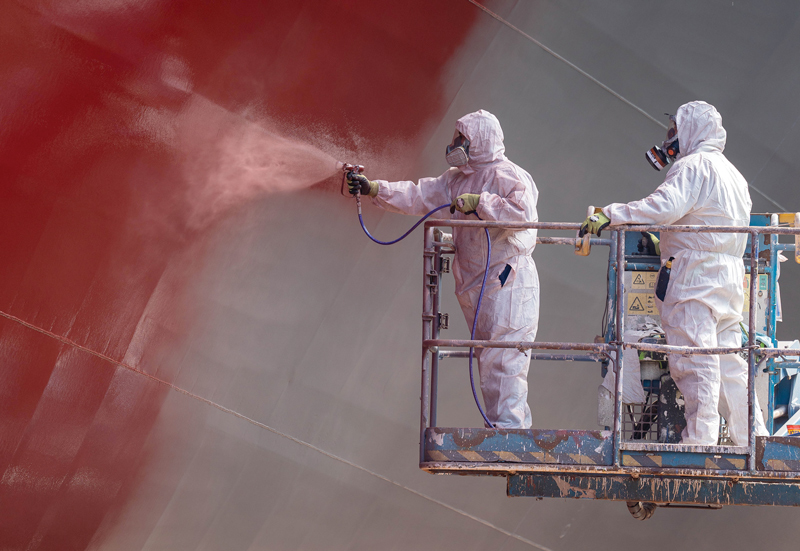
In 2021, Transport Canada launched its Quiet Vessel Initiative, a program to test technologies that reduce underwater ship noise. GIT took the challenge, partnering with six or seven Nova Scotia fishermen to coat their boats. The results came back better than hoped: a smoother hull ran quieter and burned less fuel. GIT then had the performance verified by Lloyd’s Register, the marine assurance firm—turning an anecdote into a data point a buyer could trust.
“We brought non-biased institutions in to calculate the performance, and we used these things as validation to go to the next customer and say, ‘Hey, we’ve done it with so-and-so’,” AlGermozi says.
That became the playbook: land a reference customer, get the results independently verified, use the verification to land the next one. From there, each pitch is custom-built. “We try to really understand the customer and what the vessel profile is going to be and paint the picture around what they’re going to get back,” he says. “We show a better total cost of ownership, and we emphasize the regulatory side.” Europe’s tightening rules on vessel pollution have swung doors open that a decade ago would have stayed shut.
As GIT Coatings’ client list grows, taking business from much bigger competitors, how do they, as the little fish, keep the sharks at bay? What keeps those companies from copying GIT’s technology and stealing the clients back?
“We implemented a strong and robust IP strategy from the get-go,” AlGermozi says. “I like to call it a layered colonization approach that makes it hard for others to infringe unless they buy or license from us.”
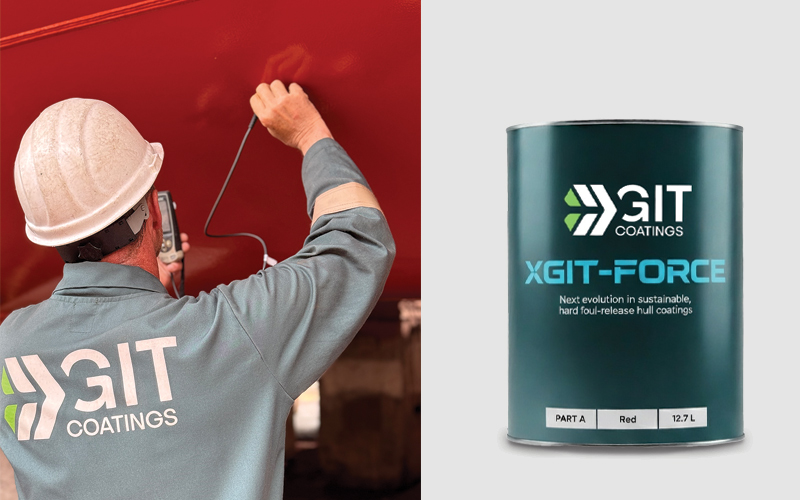
The results have compounded. Since 2022, more than 600 vessels—fishing boats, ferries, chemical tankers, container ships—have switched to GIT, a shift the company says has eliminated more than 315,000 metric tonnes of CO₂ and kept 54,000 kilograms of copper out of the ocean. In that time, GIT Coatings has seen 400 per cent growth and has raised about $20 million in capital from “a range of institutional, venture and strategic investors. Most play in clean tech, ocean health and shipping,” says AlGermozi.
The geography of that growth is its own story. GIT began in a Halifax garage with two employees in 2017, then moved to a Dalhousie University lab, then a bigger lab, and now runs from a purpose-built global headquarters that opened last fall. It’s 10 times the size of its previous home and, the company notes, carbon-neutral, with solar panels and window placement designed to cut artificial lighting. It houses all 50-plus employees under one roof.
Its customers, meanwhile, are mostly abroad. China now accounts for roughly 68 per cent of the vessels GIT coats. For a founder from Dartmouth, the surreal proof of arrival comes in the giant Chinese dry docks: “People know us—even the applicators know us. It’s definitely made this ripple across the globe.”
While much of his product is exported around the world, AlGermozi says that 87 cents of every dollar earned is reinvested at home, into manufacturing, R&D and people.
AlGermozi is candid that the market he’s in is only the beginning. “Everything around you is painted,” he points out—a reminder that anti-fouling coatings are one application of a materials platform, not the whole of it. The company has begun offering what it calls advisory services: using vessel-tracking data and AI to tell operators when and where their hulls need attention, so they can keep fuel consumption down between coatings.
The company has been using AI since well before it became as mainstream as it is today. By embedding AI into their services and internal data systems, GIT has sped up the R&D testing feedback loop by a whopping 2,700 per cent, and improved their vessel analyses, their coating performance reports and their ability to predict biofouling growth.
For now, he says, the company will resist the temptation to sprint into new markets. “We want to take that challenge when we’re ready.”
The restraint is in line with how he talks about the whole venture—as something built to outlast him. He has three young children, and he has given much thought to what he wants them to inherit. “I hope for a better industry, better planet, better life for the young ones,” he says. “I don’t want them to live in a very toxic world.”
From a curious kid with a suspicious reaction to marina water, to the president and CEO of a global company that is disrupting an entire industry, AlGermozi has come a long way. The boy who wanted to know what was on those boats grew up to co-invent what would coat them in the future—building a business, and a cause, while doing it.
Similar Articles:
Comment policy
Comments are moderated to ensure thoughtful and respectful conversations. First and last names will appear with each submission; anonymous comments and pseudonyms will not be permitted.
By submitting a comment, you accept that Atlantic Business Magazine has the right to reproduce and publish that comment in whole or in part, in any manner it chooses. Publication of a comment does not constitute endorsement of that comment. We reserve the right to close comments at any time.
Cancel