Account Login
Don't have an account? Create One
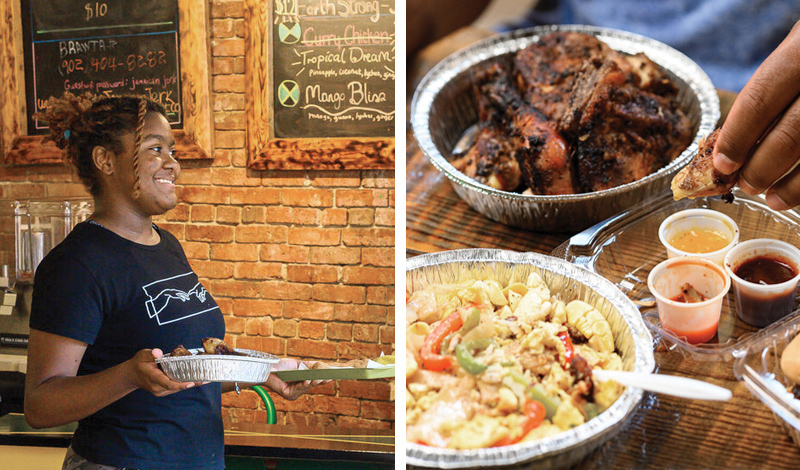
Halifax food lovers have been able to enjoy real Jamaican jerk chicken and other delicacies—all which qualify as “Di Real Ting Mon!” according to Brawta’s website—since 2019, when Brawta opened a permanent location on Grafton Street in the heart of downtown.
Owner Christine Allen and her family moved to Nova Scotia in 2014. “I started the business (in 2016) with a Christmas cake recipe that was passed down through my aunt. Other meals are recipes that were taught to me by my mother and aunt and of course my changes that I have made. It’s both family recipes and my recipes developed from family-inspired recipes and interpretations of classic Jamaican cuisine.”
Though she has progressed from a startup stall at Halifax area farmer’s markets to a sit-in restaurant, Brawta continues to be a family affair: Allen’s two daughters are business partners.
The name Brawta comes from a Jamaican expression which means a freebie, bonus or extra. In this case it means extra good!
Brawta has stayed active during the COVID 19 pandemic by offering takeout, and it will no doubt remain a large part of their business moving forward. I recently tried a takeout order of two of Allen’s traditional dishes, and thoroughly enjoyed everything.
Yaady is their jerk chicken dish ($10 for a small, $15 for a large), which you can have either with rice or with rice and peas—pigeon beans are called peas in Jamaica—with cole-slaw and steamed veggies, which is what I did. Yaady is a term for a Jamaican living abroad, originating from Yard or Yaad in Jamaica.
The chicken pieces were tender, slightly blackened on the skin, with a nice spice level, not too fiery hot, and with a pleasant spice flavour including allspice. The rice and vegetables were lightly seasoned and a tasty accompaniment to the main. There were two dipping sauces available so you could have it as hot as you like.
Their oxtail dish, Blow Wow ($17.50), is slow cooked, savoury and tender. The term Blow Wow is Jamaican slang with a similar meaning to “Oh my!” or “My goodness!”
In addition to these dishes, they serve a wide variety of other island favourites including patties, curries, ackee and salt fish, plantains, sandwiches, and a “Good Sumting: Soup of the Day.” They also offer vegetarian options including Jerk Tofu. Desserts are another important aspect of traditional Jamaican cuisine, especially their famous Naomi Fruit Cake, a Christmas tradition.
Whether for takeout or to eat-in at Brawta, it’s nice to know you can get Di Real Ting on a regular basis in Halifax.
Brawta Jamaican Jerk Joint
1567 Grafton St., Halifax, N.S.
Phone: (902) 404-8282
Email: [email protected]
Hours: Tuesday-Thursday, 12-8 pm; Friday-Saturday, 12-9 pm; Sunday, 1-7 pm
The Tidal Bay appellation, created for Nova Scotia wineries almost a decade ago, was the first of its kind in Canada.
A wine appellation is a legally defined set of rules and/or geographical designations for a specific type of wine. In this case it is a crisp, off-dry aromatic white wine blend with good acidity, designed to work well as both a drink on its own and as a match to the region’s seafood. It must be 100 per cent Nova Scotia grapes, and it must satisfy a set of rules regarding the grape varieties used, acidity and sweetness levels, and must pass a taste panel of wine professionals.
Last year was arguably the best vintage on record in Nova Scotia, with warm, dry weather for the most part, resulting in riper than normal grapes. Expect great “Reserve” reds and whites from 2020 once those are released. But this is somewhat of a challenge for Tidal Bay, as the wines must be crisp and fresh tasting, with not too much alcohol and lots of acidity. Hot weather leads to low acidity and high sugar at harvest which can result in softer, boozier wines.
Here are my impressions of the 2020 wines I’ve tasted (wines are priced in the low to mid $20 range at liquor stores and the wineries).
—Craig Pinhey
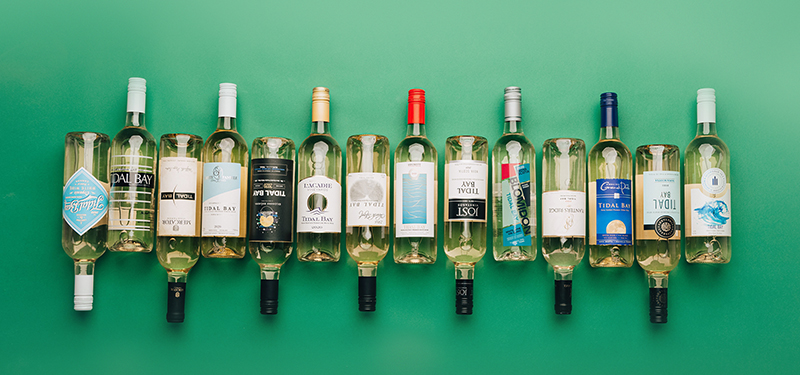
This is a blend of estate L’Acadie Blanc, Chardonnay and New York Muscat, Riesling and a small amount of barrel fermented Petit Milot. It’s pretty and very floral on the nose, with full texture and a roundness seldom seen in Tidal Bay. Still low alcohol at 11 per cent, but quite soft on the finish for a Tidal Bay. Is this the new normal due to climate change?
With 44 per cent L’Acadie Blanc, 20 per cent Vidal Bland and 16 per cent Ortega grapes, plus some Seyval Blanc and New York Muscat for florality, this is another example of the precision and consistency that Grand Pré always provides in their whites. It has a lovely minerality to it, with really fresh acidity. Classic Tidal Bay.
A very different nose on this, with a distinct and intense citrus (lime and grapefruit) aroma. It is somewhat off-dry, with great acidity and tart fruit on the palate. Winemaker Simon Rafuse described the vintage as “quite ripe, exceptionally so,” and “rounder with lower acidity and more aromatics.” He used L’Acadie Blanc, Seyval Blanc and New York Muscat in 2020.
Always dependable for good Tidal Bay, Gaspereau’s 2020 has a very citrussy nose, with a fresh, clean and crisp palate, although softer than typical. Winemaker Gina Haverstock used mostly Vidal Blanc and Seyval Blanc, bolstered up aromatically with New York Muscat and Riesling, and a touch of Chardonnay.
L&W’s showed a light, white floral nose with some pear, citrus and green apple. It is clean and fresh, with quite a dry perception, considering it is off-dry. Made from L’Acadie Blanc, Geisenheim, and Chardonnay. Winemaker Josh Horton said “2020 brought out the full potential for all the varieties we grow at L&W.”
Mostly L’Acadie Blanc and Chardonnay, with Ortega and Seyval Blanc, this has attractive pear and apple notes, but is less floral than most of the other Tidal Bays this year. Like some of the other wines, this has a quite dry perception given the residual sugar, which seems an indicator of the warm vintage.
This has a very forward, almost pungent nose reminiscent of fresh blooming spring flowers. It has around 30 per cent Riesling, which is a lot for a Tidal Bay, but is mostly L’Acadie Blanc, along with some Ortega and Geisenheim. It is lighter bodied than most of the other Tidal Bays, with fresher acidity, and a strong citrus flavour. Winemaker JB Deslauriers described it as yuzu, a citrus fruit common in Japan and Korea.
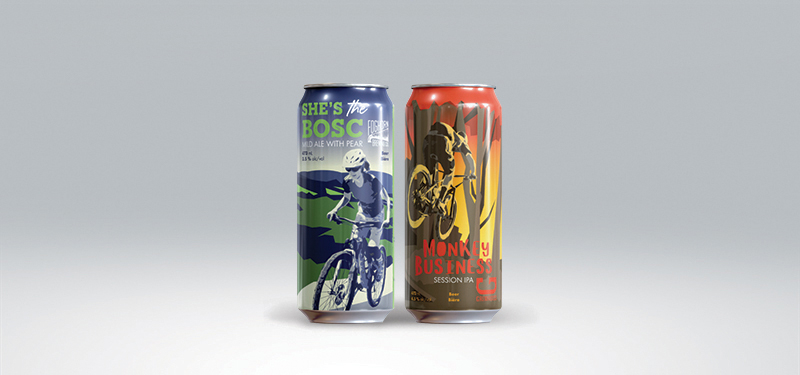
Early this summer, 15 New Brunswick breweries released a special edition beer—on their own or in collaboration—in association with Mountain Bike Atlantic, with the help of Craft Coast Canning, who donated the beautiful artwork for the biking themed cans.
They were also assisted by NBCAPA, the New Brunswick Craft Alcohol Producers Association, through their program which helps promote New Brunswick beer and cider on social media under the #NBBrews hashtag.
The idea came from last summer’s collaboration between Alma’s Holy Whale Brewing and Les Dusty Ladies women and mountain biking group based in the Moncton area. Pairing bikers and beer makes sense, as many bikers enjoy a cold local brew at home or at their favourite pub or taproom after a long, hard ride.
Although not sold at the ANBL, N.B.’s beverage alcohol producers can sell each other’s products, so places like Picaroons General Store in Saint John and CAVOK in Dieppe were selling several of the canned versions of these “bike-brews.”
Each brewery partnered with a local bike group; for example, Grimross made Monkey Business Session IPA in association with River Valley Cycling, and Rothesay’s Foghorn Brewing made She’s The Bosc, a Mild Ale with Pear, in affiliation with Queens of Carnage.
The program was successful and beer lovers shouldn’t be surprised if it returns in 2022 with a new wave of biking beers.
—Craig Pinhey
The All-Canadian Wine Championships is Canada’s oldest national wine competition, dating back to 1981. Originally held in Windsor, O.N., it recently moved to Prince Edward County, a well-respected wine region which juts out into Lake Ontario near Kingston.
Each year a group of judges gathers to evaluate over 1,000 Canadian wines and ciders; this year there were 1,365 entries from 217 wineries. Normally there are judges from coast-to-coast but COVID has resulted in the 2020 and 2021 events having mainly Ontario judges. (The author of this piece was one of the few non-Ontario judges.)
The competition receives a large number of entries from Québec and Atlantic Canada because it has several categories for fruit wines (fruit other than grapes) and also for hybrid grapes, those specially bred for cool climate terroir, which is what is found east of Ontario.
As has become expected each year, Atlantic wineries came away with an armload of medals, including five for Nova Scotia, seven for New Brunswick, and five for P.E.I.
New Brunswick’s Magnetic Hill Winery led the way with a Double Gold (Best of Category) for their Mystique Cranberry wine, which really captures the essence of that tart fruit. They also won Gold for their Framboise as well as a trio of Bronze medals for their fresh and aromatic Osceola Muscat white, their Maple Swish fortified wine, and their fun and delicious Rhubarb Pet Nat, a natural sparkling wine fermented in the bottle. The other N.B. medals were Bronzes for Winegarden Estates in Baie Verte, for their Dr. Victor McLaughlin Selection red blends, both the 2017 and 2019 vintages.
Island Honey Wine won four of P.E.I.’s medals, in various mead categories, highlighted by a Double Gold for their 2019 Nectar Sweet Mead. Rossignol Winery won the other medal, a Silver for their Wild Blueberry wine.
Domaine de Grand Pré won Nova Scotia’s only wine medal—a Gold for their Millot, a smooth, food-friendly red made from the Leon Millot grape. The other N.S. medals were for cider, including Golds for Maritime Express and No Boats On Sunday, and two Bronzes for Maritime Express.
Consumers should get out there and visit their local wineries. Be sure to give some of this liquid gold a taste.
—Craig Pinhey
Go to www.allcanadianwinechampionships.com for all the results.
CRAIG PINHEY is a Sommelier, beverage judge, consultant and writer from Nova Scotia, who now resides in Rothesay, N.B. fCraig.Pinhey.FrogsPad
Comment policy
Comments are moderated to ensure thoughtful and respectful conversations. First and last names will appear with each submission; anonymous comments and pseudonyms will not be permitted.
By submitting a comment, you accept that Atlantic Business Magazine has the right to reproduce and publish that comment in whole or in part, in any manner it chooses. Publication of a comment does not constitute endorsement of that comment. We reserve the right to close comments at any time.
Cancel