Account Login
Don't have an account? Create One

Walk into the Choices for Youth (CFY) Social Enterprise and Employment Centre on Ropewalk Lane in St. John’s and you may cross paths with the employees of Impact Construction—a social enterprise racking up job credits on Newfoundland’s Avalon Peninsula. Impact Construction is a CFY business employing young people, typically starting in their early 20s, who are also clients of the organization.
“We’re structured in a way that Impact Construction operates as its own, standalone company and it generates revenue, it pays salaries, it pays young people wages,” CFY’s Chelsey MacNeil said.
Impact Construction receives federal government support, through CFY, specifically for foundational training and supports for its young staff. That’s a key piece to how it differs from other companies: its supports for youth. A toolbox talk, separate from any on the job site, is held at the CFY base of operations each morning, giving staff a chance to connect with a variety of social supports. Those supports could come down to getting a regular bite to eat or having reliable transportation to and from the job site.
After safety training, the youth go to work at a ratio of two to one skilled tradesperson. “We certainly try and keep the experiences, for young people, as attainable as possible. So they’re not going to be in a situation where they have to do anything beyond their skill set,” MacNeil said.
For some youth participants, their pay cheque becomes an essential tool that helps break the poverty cycle. For others, the experience has sparked interest in construction as a career.

Impact Construction began when CFY undertook a 14-unit congregate affordable housing build for youth in downtown St. John’s, known as The Lilly. Thought was given during the renovation to how youth could become directly involved, thereby extending the reach and value of CFY’s spending in partnership with Newfoundland and Labrador Housing. A Train for Trades program exposed participants to the job site and work of a general contractor. The model was repeated and tweaked through subsequent affordable housing projects in the city. Impact Construction emerged, working with general contractors including Redwood Construction and Magna Construction, and established subcontractors including Terra Nova Trusses and JSM Electrical.
It’s not the only business CFY has launched as a social enterprise.
Neighbourhood, started in 2018, is the name of their gently used clothing store on the corner of Pearson and Torbay Road. The store is staffed by CFY clients with two supervisory positions. A second Neighbourhood location is slated to open in the first half of 2022.

Meanwhile, The Shop tackles a myriad of small production, manufacturing and fulfillment contracts. It started with youth manufacturing hydroponic system components and since then, there have been contracts for bottling for the Newfoundland Beer Vinegar company, small-scale screen printing and making cloth masks.
The latest CFY enterprise is Crust, a craft bakery. “We wanted to dip our toes into food production recognizing eventually we’d like to have some retail storefront,” MacNeil said. For now, the company rents production kitchen space and sells 200 to 300 handpies a week exclusively out of Bannerman Brewing in the downtown.
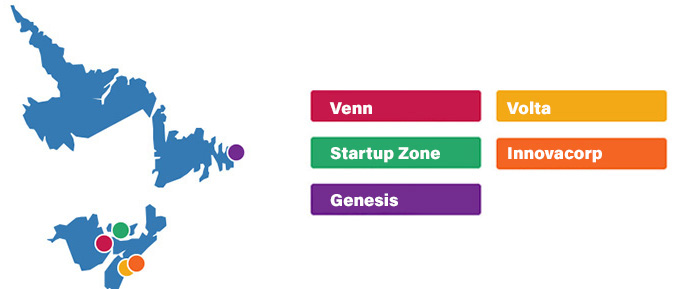
Featured incubators are regional members of Canada’s Tech Network
Started: 2013
Current CEO: Martha Casey
The pitch: “Canada’s East Coast innovation hub”
On offer: The Volta Residency is for early-stage technology startups. Residents have access to more than $50,000 in programs and discounts, including mentorship and progress meetings at least every eight weeks. Separately, the Volta Cohort is a chance for founders to secure early venture capital, with accepted companies given $25,000 and a year of mentorship and access to Volta programming. Other supports are targeted at various startup stages and demographics including pre-startup, early-startup/acceleration, supply chains, hardware, re-skilling/up-skilling, Black and Indigenous entrepreneurs, youth and women.
Alumni (sample): ADDvocacy, Dash Hudson, eOceans, Harbr, Manifold, Proposify, SmartMed, Symbi, VMOpro Inc.
Started: 2010
Current CEO: Doug Robertson
The pitch: “New Brunswick’s industry association for the technology and innovation ecosystem”
On offer: Venn Garage is an incubator program for early stage New Brunswick tech startups, before entering a more advanced accelerator program. The Market Intelligence Program feeds insights to accepted companies with less than $1 million in revenue and less than $5 million in private investment. Venn also connects employers to job candidates and provides assistance to export-oriented technology companies.
Alumni (sample): Venn does not promote specific members on its main site
Started: 1995
Current CEO: Malcolm Fraser
The pitch: “Nova Scotia’s early-stage venture capital organization”
On offer: This Crown corporation manages the Nova Scotia First Fund targeting technology companies with high growth potential. It also manages three business sites: the Startup Yard for ocean technology startups, The Labs at Innovacorp and The Bays at Innovacorp target technology startups. The Labs and The Bays serve off-site clients with a corporate address, meeting space, networking resources and office space.
Alumni (Sample): Appili Therapeutics, CarbonCure Technologies, Atlantic Motor Labs, Nexus Robotics, Planetary Hydrogen
Started: 2016
Current CEO: Sheryl MacAulay
The pitch: “Prince Edward Island’s business incubator”
On offer: The Resident Company Program is a six-month residency offering workspace, free access to events, and access to in-house specialists. The program is not tech-specific. Its Accelerator Program is a 12-week program targeting growth-oriented tech startups. Startup Zone also hosts regular events, including webinars, open to all P.E.I. businesses.
Alumni (sample): GetBooking, TopServe, Empower PEI, Reset Breathe
Started: 1997
Current CEO: Michelle Simms
The pitch: “Newfoundland and Labrador’s pre-eminent innovation hub”
On offer: The three-year Enterprise incubator for technology startups offers access to mentorship, office and working space plus workshops and sessions. It’s for companies with some traction in the market but less than $1 million in annual revenue. The Evolution program is an eight-week pre-incubator program that pushes entrepreneurs to better understand their target market, connect with potential mentors and finesse their pitches. The Women in Tech peer group fosters connections and works to retain more women locally in the technology sector. The Startup Visa targets immigrant entrepreneurs.
Alumni (Sample): Verafin, Virtual Marine, Mysa, ClearRisk, Hey Orca!, Genoa Design International
Halifax Innovation District
IGNITE innovation hub
Emergence (P.E.I. BioAlliance)
Nova Scotia Innovation Hub
Ulnooweg Development Group
Memorial Centre for Entrepreneurship
New Brunswick Innovation Foundation
Saint Mary’s University Entrepreneurship Centre
Centre for Ocean Ventures & Entrepreneurship
Creative Destruction Lab Atlantic (Halifax)
Emera IdeaHub
Planet Hatch
Propel ICT

The inaugural executive director of the McKenna Institute at the University of New Brunswick, Adrienne O’Pray, says the institute has launched quickly on the heels of former premier Frank McKenna’s seed investment. UNB announced a $5-million contribution from McKenna in September, for a new university-based effort supporting “digital transformation” in the province.
The institute—for which McKenna is spearheading a $50-million fundraising initiative—is focusing on three areas: building talent, engaging communities and exploring and supporting ideas tied to emerging industries.
Year one will focus on talent acceleration. Looking ahead to years two and three, O’Pray said the plan is to increase the level of outreach by offering programs in urban and rural areas with the core message that “digital” and “data” is not just for coders, but for businesses of all types and policy developers. “We want to be out in communities and talking about what does it mean to be a digital citizen? How is our world changing? What does that mean for us as a society? How are we using data?”
O’Pray said over 150 interviews with people active in the tech and business development space helped to shape the institute’s plans.
The institute is working to launch more than one related research chair, including a chair to promote diversity and inclusion in computer science. Looking outside the university, the institute is investigating math enrichment programs that could be offered in addition to the existing K-12 school program. They’re also working with Ulnooweg in Nova Scotia and the Joint Economic Development Initiative in New Brunswick to introduce a new Indigenous youth program with digital training. The institute also aims to help local businesses capture new opportunities in digital health, digital oceans and other areas where the region has shown strength and potential.
O’Pray said the idea for the institute started around October or November of 2020, after McKenna was inspired by author Gordon Pitts’ Unicorn in the Woods. The book looks at the potential for high-tech innovation outside major urban centres, through the origin stories of New Brunswick’s Radian6 and Q1 Labs. The companies were built and sold for a combined $1 billion.

Breaking the Silos
Moya Cahill says Atlantic Canadian technology companies are thankfully “not lobsters in a trap,” obsessed with pulling each other down. Instead, she’s seeing a jump in useful collaborations and cross-promotions.
“We’re seeing some really smart people coming and taking down the boundaries,” the CEO and co-founder of PanGeo Subsea said during a September panel session on green jobs hosted by econext (formerly the Newfoundland and Labrador Environmental Industry Association, NEIA). She pointed to collaborations under the umbrella of Canada’s Ocean Supercluster as a highlight.
PanGeo Subsea itself is part of a cross-jurisdictional effort being facilitated by the supercluster program. The company is partnered with British Columbia-based Cellula Robotics and the Marine Institute of Memorial University of Newfoundland and Labrador on the GeoScan Project, for example. The goal is to reconfigure PanGeo’s “Acoustic Corer” with Cellula’s robotics to create a system with wider-area seabed scans, to depths of greater than 30 metres below the seabed. The project was estimated at $3.4 million, with $2 million in support through the national supercluster.
PanGeo was acquired earlier this year by Newfoundland and Labrador-based Kraken Robotics and the view of the new future with Kraken is “really exciting,” Cahill said.
The econext panel also included techNL CEO Paul Preston and Memorial University of Newfoundland and Labrador associate vice-president responsible for public engagement and external relations Rob Greenwood, who has a long list of credits in public policy and economic development work.
Greenwood described his expectation of even more collaborations across Atlantic Canada. With a rapidly aging population in much of the region and potentially fewer people, technology and service companies will naturally be doing more with less in the years ahead. Greenwood said the time is now for individuals to challenge their status quo, become more innovative and establish the connections they’ll need for the future.
On the plus side, said Greenwood: “The startup community in this city and in this region—it’s hopping.”
Comment policy
Comments are moderated to ensure thoughtful and respectful conversations. First and last names will appear with each submission; anonymous comments and pseudonyms will not be permitted.
By submitting a comment, you accept that Atlantic Business Magazine has the right to reproduce and publish that comment in whole or in part, in any manner it chooses. Publication of a comment does not constitute endorsement of that comment. We reserve the right to close comments at any time.
Cancel