Account Login
Don't have an account? Create One

Nora Duke believes environmental, social and governance principles are more than just catchphrases. They’re the building blocks of a better future. Here’s how she stacks them at Fortis Inc.
The office where Nora Duke holds sway as executive vice-president, sustainability, and chief human resources officer of Fortis Inc. offers floor-to-ceiling windows through which the light from St. John’s inner harbour streams like an old friend. “I love this building,” she says.
She should; she helped design it. Before it went up on Springdale Street back in 2014, when she was CEO of the diversified energy company’s property arm, she ensured that it complied with the most stringent green building standards in the world. The exec who once wanted to be an architect (before her first physics course after high school derailed the plan), clearly thought it was the right thing for a major power corporation to do in a rapidly warming world. Besides, she says, it was fun.
“I worked with a very cool architect here locally. I always felt it was my project and I was very proud of it. Maybe, a little bit of the architect in me came through.”
During her 35 years climbing the ladder at Fortis Inc., she’s helped the North American electric and gas utility grow its assets from a few hundred million dollars to $56 billion. Last year, it posted earnings of $1.2 billion on revenues of $8.9 billion. Its 9,000 employees served customers in five Canadian provinces, nine U.S. states and three Caribbean countries.
It’s fair to say Duke’s signature is everywhere: vice-president, customer and corporate services, Newfoundland Power (1999-2003); vice-president, hospitality services (2003-2007), and president and CEO, Fortis Properties Corporation (2007-2015); and executive vice-president, corporate services and chief human resource officer of Fortis Inc (2015-2017).
But it may be that her current role—which tacks that all-important word “sustainability” to the title she’s held for four years—is her most professionally and personally rewarding so far. “The whole area of environmental, social and governance principles has really come to the forefront recently,” she says. “I’m really excited about leading this.”
She’s not alone among its cheerleaders in the North American corporate landscape, where environmental, social and governance, or ESG, has supplanted just about every other prominent management philosophy in just a few years. Put simply, the framework incorporates factors that traditionally have not been part of the financial equation, either for investors or companies that pay dividends, but are now considered essential. Factors like: how companies deal with climate change, pollution, and natural resources; how they trade and do business with the rest of the world; how they treat their employees; and how they build faith among, and deliver value to, their customers. You know… the easy stuff.
What’s more, ESG is big business. According to a 2018 article in Forbes Magazine, it accounts for about $20 trillion a year in global assets under management precisely because, increasingly, shareholders take it very seriously: “In many important markets, including the U.S. and the EU, ESG integration is increasingly seen as part of fiduciary duty. The idea that investors who integrate corporate environmental, social and governance risks can improve returns is now rapidly spreading across capital markets on all continents.”
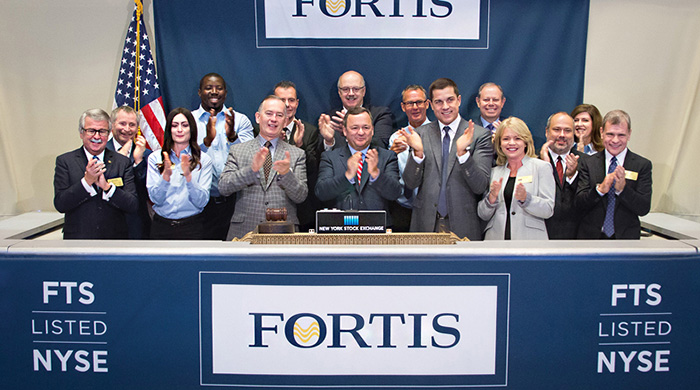
All of which, Duke says, comes to roost at Fortis (specifically, at her doorstep at Fortis) almost daily. “Years ago, if a company started talking about social factors, environmental factors, it was kind of over there [in the corner],” she says. “But now, what we’re seeing, what’s loud and clear from our stakeholders and others, is that embedding these things into how you run your business is core.”
With her imprimatur, more than 70 per cent of Fortis’ $4.3 billion capital plan is dedicated to what its Sustainability Report calls “asset resiliency, modernization and cleaner energy initiatives.” That means, for example, its Tucson Electric Power (TEP) subsidiary will generate most of its energy for sale with wind and solar power systems by 2035. Over at FortisBC, the goal is a 30 per cent reduction in greenhouse gas emissions from customer energy use by 2030.
Equally progressive under her direction is Fortis’ hiring policy. Forty per cent of its directors are women. By some estimates, that’s twice the North American average at large, private corporations. “It’s one of the things I’m probably most proud of,” she says, as the sun flashes off the boats in the harbour 12 storeys below.
“I lead our executive women’s group here,” she almost beams. “When you get them together, they’re inspired and they’re impactful and they’re doing wonderful things. In the last five or six years, we really started to take a more purposeful role around gender and gender leadership.”
Duke, who has a B.Comm (1983) and an MBA (1989) from Memorial University and who earned an Atlantic Business Magazine Hall of Fame designation in 2013, certainly believes that large companies like hers can do well by doing good. But it’s also conceivable that, without her, Fortis might have difficulty doing as much good as it does. An innate sense of what’s “right” seems to have been born and bred in her.
“In my early years, until I was six, I grew up in Fox Harbour, Placentia Bay,” she says. “I kind of just think of my parents, who were very humble, who didn’t have great wealth. But they were leaders in their community. For them, it was all about being community champions and doing the right thing. I think they shaped my own thinking.”
If that thinking has shaped at least some of the major policy shifts in HR, corporate responsibility and environmental stewardship at Fortis over the past decade, it seems certain it’ll continue to exert an influence as the company, and the precarious world in which it operates, grows steadily more willing to consider alternatives to old ways of thinking and doing. To consider, in effect, a new design for living and working.
“It’s not about structures and bureaucracy,” she says, next to the window in the office tower she helped design.
“It’s about making it happen. It’s about leaning in.
Duke says she and her siblings (two sisters and a brother) are exceptions to an old Newfoundland and Labrador rule. “You’ve heard it: People here have always had to go elsewhere for work. But not us. We’ve all managed to stay in the province and have really successful careers and families.”
Daughters Emma and Elizabeth are millennials on the go. But neither seem interested in pursuing their mother’s career trajectory, which suits mom just fine. “One’s going to med school right now. And the other is an occupational therapist. So, they both come to the health care area, and I think that’s great.”
“I love to catch fish,” Duke says. “My husband, Terry, dreads it because he has to clean the fish. We used to use jiggers, which allowed you to catch more than one cod at a time. That’s now taboo. There’s just something about going out on the water. When we get the chance to go out I actually love it.”
When not fishing, Duke enjoys a good afternoon of berry picking. “People say: ‘How can you do that, it’s so boring?’ But I say there’s nothing like getting out there in the peace and quiet. It just blows the cobwebs right off you.”
Before the pandemic, Duke spent a lot of time travelling with her family. It’s on the agenda again. “Coming from Newfoundland, Europe is a bit more of a destination for us. It’s just something about the culture. We are definitely aspiring (to travel) now.”
Comment policy
Comments are moderated to ensure thoughtful and respectful conversations. First and last names will appear with each submission; anonymous comments and pseudonyms will not be permitted.
By submitting a comment, you accept that Atlantic Business Magazine has the right to reproduce and publish that comment in whole or in part, in any manner it chooses. Publication of a comment does not constitute endorsement of that comment. We reserve the right to close comments at any time.
Cancel