Account Login
Don't have an account? Create One
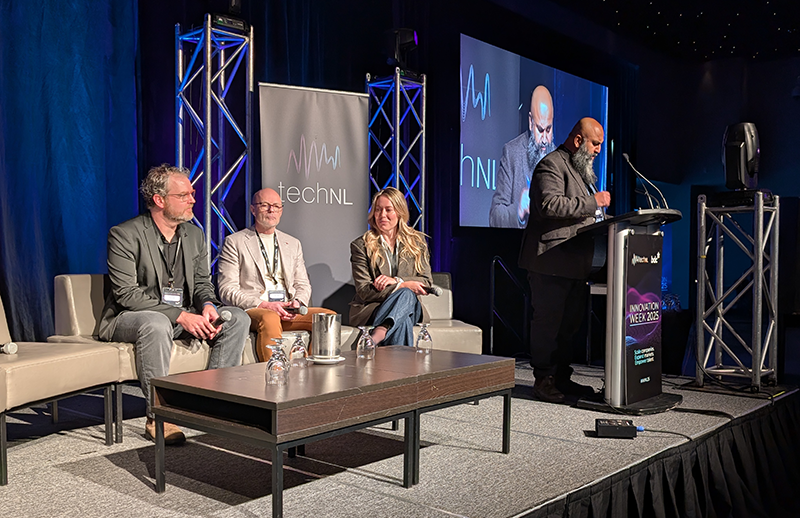
It was the worst-kept secret at techNL’s recent Innovation Week event: CoLab has something brewing.
CoLab AI’s news dropped this week. The software company, already named one of Canada’s fastest-growing tech companies—led by co-founder engineers Adam Keating and Jeremy Andrews—has a new US$72-million financing deal, driven by Intrepid Growth Partners. The investment fund was started by former Canada Pension Plan Investment Board chief executive Mark Machin. More than expansion fuel for the company, the news is hailed as another serious endorsement of Newfoundland and Labrador’s technology sector.
At the sector association’s conference, techNL CEO Florian Villaumé said he expected CoLab would become one of the “huge drivers of growth” in the growing local sector in the near-term, starring alongside legal work AI-assist software company Spellbook (with a US$50 million deal earlier this year) and, with its roughly $1.6-billion valuation, longstanding subsea expert Kraken Robotics. There’s also the steady leadership of Nasdaq Verafin, which continues “to grow and scale and procure” locally, even after the financial fraud detection firm was acquired by Nasdaq in 2020 in a US$2.75-billion deal.
In addition to those companies making national headlines, Villaumé boasted a blooming local tech ecosystem, complete with start-ups, stable tech SMEs with potential for scale, and “scale ups” with solid growth and momentum. He made specific mention of wireless power tech company Solace Power and hologram system creators Avalon Holographics.

“You have tons of other companies that could significantly grow over the years,” he told Atlantic Business Magazine. This after delivering a speech reiterating techNL’s goal of seeing the sector as a $2.5-billion contributor to provincial GDP by 2030 (having already topped $1.8-billion) and becoming the leading industry in the province by 2050.
Those goals demand big private-sector investments, as well as the ability to successfully scale and produce. What that looks like and what it requires in a practical sense can be very different for different companies, and it will ultimately mean working with the private and public sectors through a variety of labour needs, regulatory and procurement system barriers.
“For us it is very important that we are very intentional in the type of support we give to each of them, because they have different challenges,” Villaumé said of the required advocacy and work to be done.
Governments, of course, can make a difference in the sector’s growth trajectory. Federally, more opportunity for the tech sector may come from a planned Office of Digital Transformation. And there’s a planned federal government spend of roughly $1 billion ($925.6 million over five years) for “sovereign” public AI infrastructure, as well as new tech spending under the federal Defence Industrial Strategy, the latter to be released in 2026.
Provincially, in advance of the recent provincial general election, techNL reached out to all parties with a list of recommendations for supporting the sector. The list spoke to a need for transparent funding supports, openness to larger contributions for rapidly scaling firms, new sector marketing, talent recruitment, intellectual property (IP) protection measures and cutting barriers to interprovincial business.
Villaumé said the new leadership needs to see the sector for what it is and what it can be, moving with urgency to meaningfully support companies with promise and momentum. He said a place to start would be creating new openings for local tech procurement at the provincial level, particularly in high-spend areas like healthcare. There, he said, successful implementation of new tech has the potential for improved productivity and lower costs. The initial work can bring in needed funds for a company as well as build credibility in national and international markets—bringing success to the business and new money into the province.
He also urged faster timelines on approvals for tech research and development projects. “The speed of business is accelerating. We need to match what’s happening outside the province, and be even quicker,” he told Atlantic Business Magazine.
A response to techNL issued before election day from the Progressive Conservatives and newly elected premier Tony Wakeham stopped short of committing to all recommendations, particularly those coming at direct cost to government. However, it suggests the new government will support the concept of innovation in procurement, specifically so the terms do not unintentionally bar local companies from accessing capital investments.
“We will take a local-first approach to ensure that local innovators have an advantage,” then-candidate Wakeham wrote. He committed to expanding tech education opportunities in K-12, and to creating “upskilling” opportunities for the existing, local labour force. He also committed to the creation of an Intellectual Property Office, to help local companies protect their IP and intangible assets.
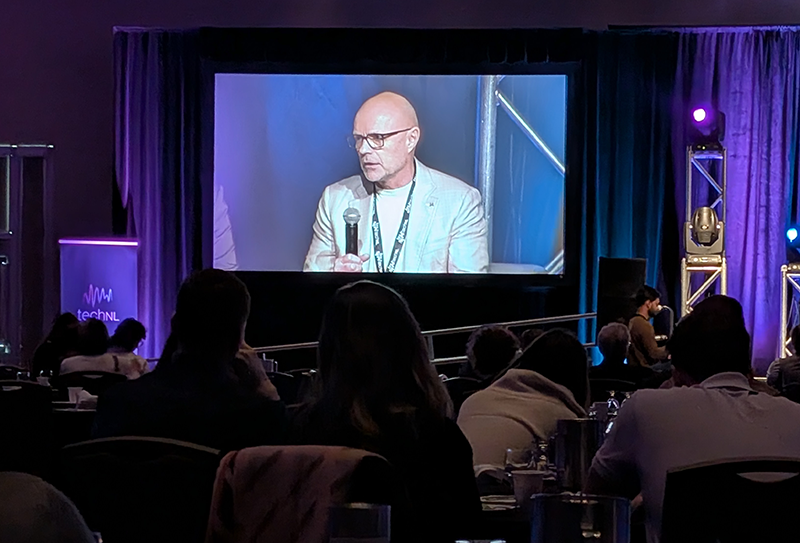
All of the recommendations can have meaningful impacts. On procurement, as an example, at the techNL conference, Kraken Robotics’ chief technology officer David Shea took part in a panel on international markets, sitting alongside Nasdaq Verafin’s Stephanie Champion and Neil Chaulk of Solace Power. He shared the story of Kraken’s challenging start, where the company’s first major break was in testing with the U.S. Navy and that its first major contract wasn’t with the Canadian government but the Australian government. It was nearly a decade before the company sold Canadian, he said.
These days, Kraken has about 400 people on staff, about 150 of those in Newfoundland and Labrador, with the rest in offices around the world. Shea said the company has built its success on direct presence and product that meets client demand. Essentially, living up to promising introductions is at the root of the company’s growth and its significant contribution to Newfoundland and Labrador’s tech scene.
“Ultimately, people do business with people. …If you’re working with people and they trust your product, they trust what they’ve seen, they’re going to tell other people about it,” he said. •
Similar Articles:
Comment policy
Comments are moderated to ensure thoughtful and respectful conversations. First and last names will appear with each submission; anonymous comments and pseudonyms will not be permitted.
By submitting a comment, you accept that Atlantic Business Magazine has the right to reproduce and publish that comment in whole or in part, in any manner it chooses. Publication of a comment does not constitute endorsement of that comment. We reserve the right to close comments at any time.
Cancel