Account Login
Don't have an account? Create One
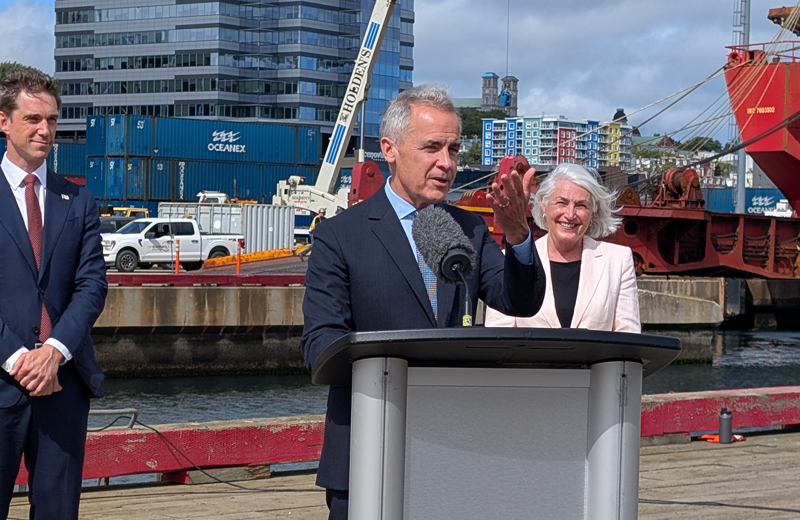
Standing on a Newdock wharf that juts out into St. John’s Harbour on Monday, September 8, unmoved by a steady, sustained wind of 35-40 km/h, Prime Minister Mark Carney re-announced a suite of federal financial programs. Their collective intention is to “protect, build and transform” industries in the face of shifting geopolitics, and ongoing trade actions against Canada by both the U.S. and China.
He made a point of highlighting a $1 billion program for small business called the Regional Tariff Response Initiative, declaring $80 million of the total fund will be dedicated to businesses throughout Atlantic Canada. That support is available to all tariff-affected sectors including agriculture and seafood, with funds being distributed through the Atlantic Canada Opportunities Agency (ACOA).
The collection of new and updated federal response measures was first revealed on Sept. 5. Other measures include a Buy Canadian policy for federal government purchasing, a new maximum loan size for the Business Development Bank of Canada (moving to $5 million from $2 million), and an additional $450 million over three years for worker re-training to be distributed by way of the federal-provincial labour market development agreements. Those are all totals for the programs nationally.
There is also a $5 billion “Strategic Response Fund” offering support for “sectors disproportionately exposed to U.S. tariffs and global trade risks, such as automotives, steel and aluminium.” That fund, according to its description on a Government of Canada website, has the flexibility to aid other high-value sectors, but it’s unclear what if any businesses in Atlantic Canada will attempt to qualify and ultimately tap in.
For now, business owners are being encouraged to look at what measures may apply to them and the details rolling out on each program.

The federal announcements of support have been welcomed by business representatives, as a first step. However, it’s widely acknowledged that what has been announced will not be a cure-all for the pains of the ongoing, global trade wars.
In Atlantic Canada, you can look specifically at the fisheries. In terms of re-tooling for new products and diversifying into new markets, the $80 million highlighted by the Prime Minister in St. John’s as a support for all small businesses across Atlantic Canada is dwarfed by the Atlantic Fisheries Fund, meant to assist the entry of Canadian product into new markets. When announced, then-MP Judy Foote said it would help local fisheries be more internationally competitive. It started in 2017 at a total $325 million, or $245 million more than the newly announced tariff response offered for all regional SMEs.
The Fisheries Fund and fisheries example speak to the immense challenge of diversification. Part of where the industry worked to diversify was in Asia, moving product into the Chinese market, only to be caught in recent trade disputes.

Select seafood, including mainly shellfish, have been hit with a 25% tariff by China, set in March. The trade action has been challenged but has already had an impact. Looking at exports of live lobster from Nova Scotia as an example—the region’s most lucrative fishery in recent years—year-over-year sales into China from April to July inclusive dropped from 5,639,701 kilograms down to 2,883,648 kg, or to roughly half.
At the Nova Scotia Seafood Alliance, executive director Kris Vascotto said it’s about a $76 million drop in terms of value. That’s just the losses from the export of live N.S., without including related impacts such as unsold inventory, and it outstrips the small-business relief announced by Carney.
Vascotto said seafood producers and associated companies are looking at the details of new federal efforts and welcome the announcements. However, they can’t say to what degree it will sustain industry, in the event of prolonged tariffs and trade uncertainty.
“There is an incredible need for the government to continue their diplomatic efforts,” he told Atlantic Business, demonstrating where hope is sitting.
In Newfoundland and Labrador, the Association of Seafood Producers (ASP) acknowledged in a statement from ASP board chair Kim Quinlan that members are also feeling the pain from the Chinese tariffs, the second-largest market for member product, leading to uncertainty for producers and thousands of fish plant workers.
“ASP is committed to working with both governments to ensure stable, fair trade that allows our seafood to remain strong on the world stage,” the statement reads.
There was no direct comment in terms of to what degree the announced measures would or even could help.
In a statement to ABM, Unifor National President Lana Payne said Buy Canadian will be essential and the announced federal programs are welcome, but not enough.
“Workers in Atlantic Canada, who are confronting some of the highest unemployment rates across the country, need more,” she said, in the statement.
Payne highlighted the seafood sector and tariffs from China but also tariff threats from the Trump administration.
Unifor wants the federal government to do more work with labour unions to develop “targeted tariff relief measures” for workers.
According to the Canadian Federation for Independent Business (CFIB), the good and bad of the federal relief announcements are going to come down to the fine print and speed. “It’s good to see this tariff relief program extended to all sectors, but the real test will be in the details, who qualifies, how simple the process is, and how quickly ACOA can get support out the door,” said CFIB’s Atlantic director Frédéric Gionet in a statement.
The CFIB rep is hoping the Government of Canada applies lessons learned from the pandemic response and the Canada Emergency Business Account (a.k.a. CEBA) program for small businesses.
Many businesses were already carrying debt loads as a hangover from the pandemic and other disruptions before the trade wars started to creep in. Nationally, the CFIB has stated one in five CFIB members polled, dealing with tariff costs, believe they will not last more than six months without some relief. The CFIB has about 10,200 members in Atlantic Canada.
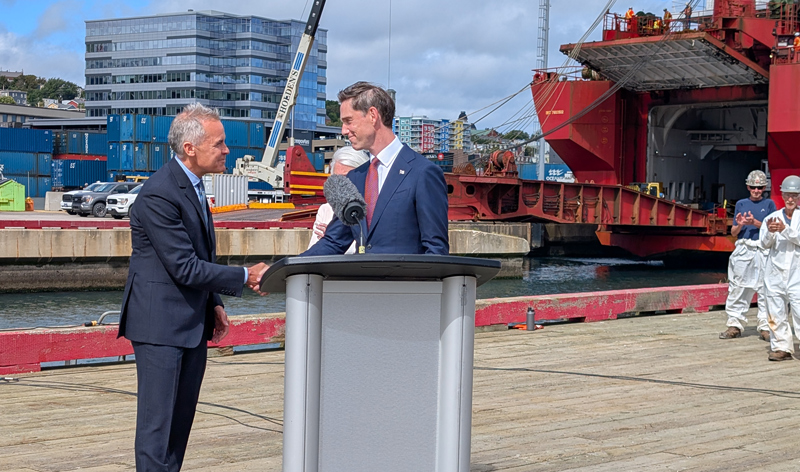
The organization wants the federal government to move quickly to return tariff revenues (from Canadian-set tariffs or countertariffs) to small firms, through both direct and indirect investments. The Canadian government may argue that’s exactly what the suite of announced funds and programs are doing. At the same time, while in St. John’s, the Prime Minister spoke to the need to be aware of spending and referred to the Fall federal budget where it’s expected there will be greater understanding of how and where the Carney government will be financing its planned spending.
In the meantime, per ACOA’s website, for the small business support, applicants will have to show “at least 25 per cent of their sales are to the U.S. and/or China, or demonstrate that they, or the businesses they support, have been directly affected by ongoing trade disruptions, including the U.S. and China tariffs or Canadian countermeasures.” It covers costs and losses back to March 21.
The funds offered are for investments in new technology to enhance productivity, attempts to expend into new markets, regulatory work in terms of complying with standards for new product and markets, recruiting, research and development and more aimed at growth, productivity and diversification.
Carney said people and businesses in Atlantic Canada should also be looking ahead to take advantage of major projects in the works. He mentioned being “proud” of the progress on plans for a hydro deal for the Churchill River, including capital-heavy projects at Churchill Falls and Gull Island. The Prime Minister also highlighted the Bay du Nord offshore oil development and new Defence spending.
He mentioned the potential benefits for small business from major projects, as part of a response when asked about the scale of the small business support fund. He also said the allocations around the country from the national programs and funds come from calculations tied to GDP and population.
“And we’re going to add to this as necessary going forward,” he said.
NOTE: This story has been updated to include comments received from Unifor.
Similar Articles:
Comment policy
Comments are moderated to ensure thoughtful and respectful conversations. First and last names will appear with each submission; anonymous comments and pseudonyms will not be permitted.
By submitting a comment, you accept that Atlantic Business Magazine has the right to reproduce and publish that comment in whole or in part, in any manner it chooses. Publication of a comment does not constitute endorsement of that comment. We reserve the right to close comments at any time.
Cancel