Account Login
Don't have an account? Create One
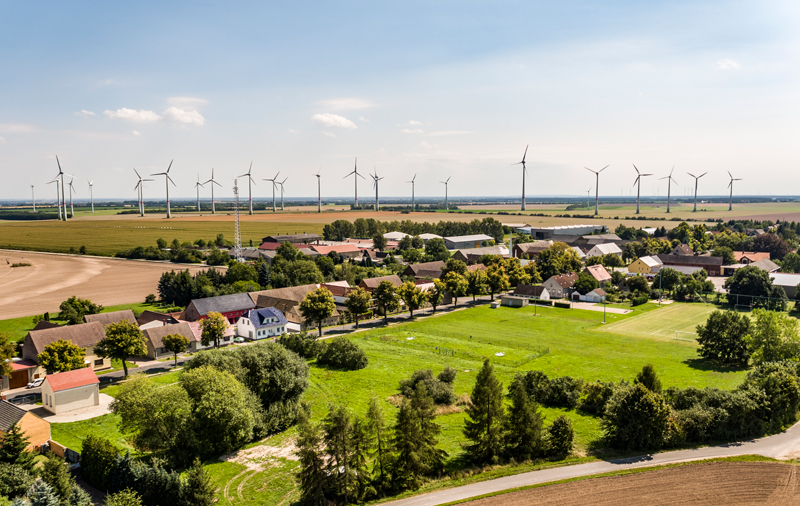
Driving about an hour and a half southwest of Berlin, Germany, you’re on a country road. It’s a single lane in either direction, winding past fields punctuated by postcard hamlets: farmhouses, old and modernized, machinery, “marshmallows” of bundled animal feed and, particularly on approach to the village of Feldheim, wind turbines.
It could easily be a drive through small town Nova Scotia, or rural Newfoundland and Labrador.
The ongoing, global energy transition involves ending unnecessary burning of fossil fuels. For the people in Germany, just as in Atlantic Canada, it means continuing the switch from common reliance on home heating oil and coal to other energy sources (Germany has committed, by law, to phase out coal by 2038).
More than household demands, the ongoing transition also requires finding new means of powering global industry, down to the creation of fertilizer on these German fields, with industry’s much larger levels of energy demand. As oil is a global commodity, the solutions proposed for industry in the new energy economy are often not localized.
In Atlantic Canada, proposals incorporating this idea of local production for wider use have been tabled for years as part of much larger, natural resource development plans. The unifying feature remains energy produced by private companies mainly for export, to capture a piece of the new energy sales nationally and internationally. That’s true for the hydrogen-to-ammonia facilities, the roughly sketched Eastern Energy Partnership, and Nova Scotia’s dovetailing “Wind West” aspirations.
The proposals in Canada are for new heavy industry, collectively akin to the scale of offshore oil and gas plays. It’s essential for related, public debates and analysis to grasp the difference between the two: domestic service and commercial energy product/global commodities.
It’s an easier thing to appreciate with even the briefest visit to Feldheim. The community situated along this winding, rural roadway is considered part of the larger municipality of Treuenbrietzen, in the state of Brandenburg. It has a volunteer fire department, community centre and a population of about 130 people. Since 2010, it is also Germany’s first energy self-sufficient village.
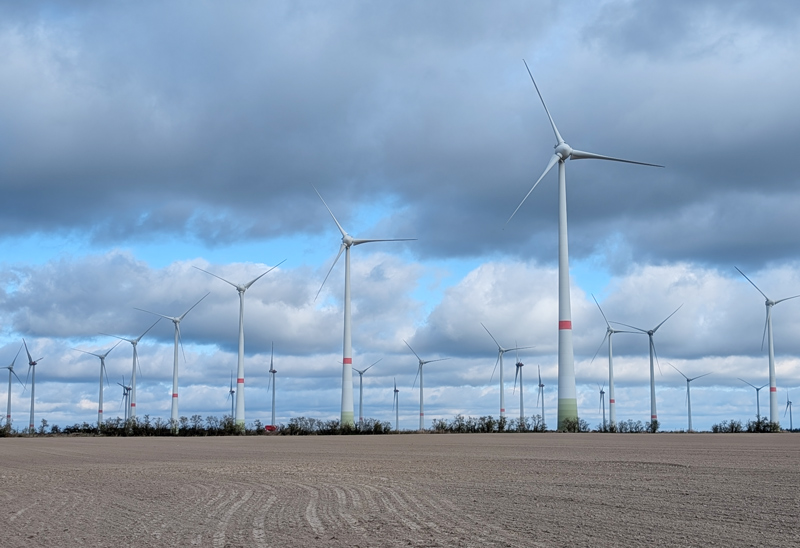
Feldheim is celebrated as a prime example of successful, small town renewable energy development with social license. The community saw its first wind turbine in 1995, the first of four, thanks to a young entrepreneur named Michael Raschemann, who stretched to lease land from local farmers and finance the construction. Two years later, he and his wife Doreen, and business partner Joachim Uecker, founded the renewable energy company Energiequelle. At the time they were working from their kitchen tables. The company now has more than 600 employees and over 850 projects completed. Uecker left in 2019 and Michael Raschemann manages things, with subsidiaries from Finland to South Africa.
But let’s not go too far afield. We’re talking about Feldheim. And in Feldheim, local interest in renewables really started to rise three decades ago, with talk of those first wind turbines.
It wasn’t an instant switch to all-renewable electricity and heating supplies. More turbines were added in spurts, with some locals investing to help them rise. Still, there was a long period before broad change and most homes in the area remained dependent on home heating oil for years.
During those years, the village’s economic mainstay, farming, became seriously challenged. By the mid-2000s, local farmers—producing predominantly potatoes and sugar beets at the time—were experiencing a drop at the farm gate. Members of the local co-operative found their crops fetched less than usual returns and far less than they needed to continue their business status quo. Discussions in the village turned to the likelihood of local job losses, and ultimately a declining community.
It didn’t help that other living costs were rising. Not least of all, Germany was seeing rising energy prices.
“The original idea to actually make the village energy independent came from the villagers themselves,” said Kathleen Thompson, a freelance tour guide. Thousands now visit Feldheim every year to hear about the community’s energy transition.
The farming families of Feldheim began discussions with Energiequelle, and a plan emerged.
Farmers were already changing their usual agricultural business activities. They started producing fewer beets and more corn and grains. Some turned to livestock, with pigs, or cows for dairy farms. Working out the plan with Energiequelle, in 2008 they opened a biogas plant a stone’s throw from the company’s wind turbines.
While plenty of people have come to hate the word, choosing a biogas plant was about synergy. The farmers had more manure now, plus large corn plants and cereal—perfect to sell as infeed for the biogas plant. In turn, the plant produced heat, and a by-product the farmers could purchase and use in fertilizer. They could operate the plant themselves, keeping their local business costs down by using it as an outlet for farm waste, excess product and for cheaper farm supply on the other end, in the fertilizer by-product.
“They’re not engineers, so they actually went into business with Energiequelle, a 50-50 partnership, and Energiequelle looks after the technical and commercial side of the business and the farmers are responsible for the day-to-day running,” Thompson told Atlantic Business Magazine.
The main output of the plant—the core product—is heat. The gas plant currently meets about 85 per cent of all local heating supply needs. And the corporate partner, Energiequelle, was further accepted and integrated into the community.
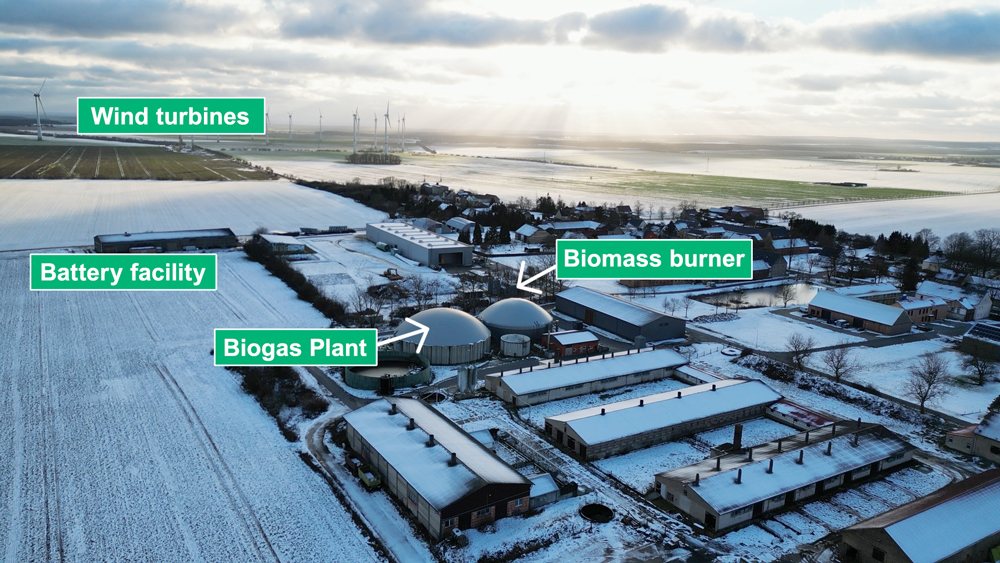
Standing along a single-lane side road, the buildings of the gas plant—including storage for the input and output, with a power-producing capacity of 526kw—are relatively plain. They’re similar in scale to the farm buildings seen throughout the region. In the grand scheme of things, they’d be easy to miss if puttering around off the highway.
It’s not anything like the scale of the Come by Chance oil refinery, or the former Northern Pulp paper mill. It’s not a heavy industry site or national megaproject. It’s not the Lingan coal (heavy fuel) power plant.
A wood chip burner, with a footprint along the lines of a standard baby barn, offers additional heat during peak periods in winter. Set on a lot just beside the gas plant, the additional, smaller power producer is also fed by locals. It uses biomass—by-product from a small number of local forestry businesses and material pulled from a managed, local forest.

In 2010, in an essential piece of work for the broader community, the district heating system was installed to bring heat from the biogas and biomass facilities to properties throughout Feldheim. The distribution system was established with help from Energiequelle, the European Union, German, state and local governments (1.73 million euros in overall investment, with about 830,000 euros being public funds).
Local property owners besides the farmers were given the option of buying into the energy developments. For 1,500 euros (using today’s dollar and exchange, it would be about $2,400 Canadian) you could get a connection to the new heating system. Another 1,500 euros and you could get a second connection, to receive electricity from the growing Energiequelle wind farm. Most people opted for both.
The new heating system alone allowed the community to collectively avoid the use—and cost—of about 259,000 litres of heating oil every year. Biomass and biogas are not the best options in thinking purely about greenhouse gas emissions, as both have their own emissions and related environmental costs, but they were the choice chosen by the local community. And it was part of establishing the social license for larger, renewable energy projects—including a larger wind farm and (as detailed in a moment) solar development—with reach well beyond the small village.
Cost was a main driver of the adoption of the new energy by local people and the greater offering of social license. Regular heating costs in Feldheim are US7.5 cents per kilowatt hour (/kWh), or roughly a third of what people in this part of Germany pay for oil heat. And when it comes to electricity, the cost on the grid in Feldheim is US12 cents/kWh, or under a third of the average price in Germany.
Prices on both local grids (heating and electricity) have remained steady over more than a decade. The cost for local users is reassessed every 10 years. It did go up slightly due to a surcharge introduced as a result of the German government’s Renewable Energy Sources Act. However, prices dropped back when the government abolished that surcharge back in 2022.
The energy pricing, as it is, would not have been possible without the contribution of public funds and loans for the heating distribution system.
Energiequelle added a battery facility just down the lane from the gas plant, in view of its local wind turbines. The facility was the world’s largest battery energy storage project when it first came online in 2015. It houses roughly 4,000 lithium-ion modules, for a total of 10 MW of power storage capacity. It helps to compensate for regular variations in the area power supply and demand, working with the renewable power.
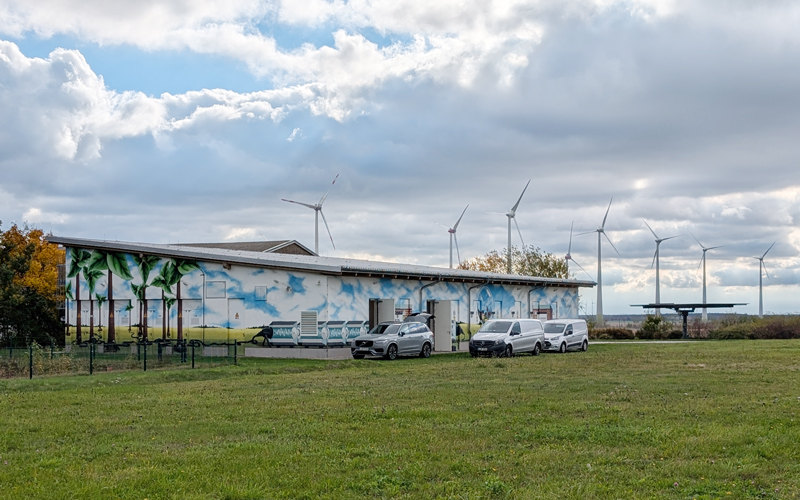
That includes area solar. The company also acquired Selterhof, a former East German military base about five minutes from the centre of Feldheim. It took on the task of cleaning up the roughly 45-hectare property, tearing down more than 85 buildings. Beginning in 2008, it built a solar farm, with enough modules for 2,748 megawatt hours of output annually, or enough power for about 600 four-person homes in Germany.
Apart from cheaper power, locals in Feldheim benefit from their developments through various jobs now available in running, maintaining and in small part supplying resources for the different renewable power projects. There is the interaction with traditional agriculture business. Energiequelle and the corporations established for the various projects pay business taxes to the local community, providing for local infrastructure needs down to supporting community street lighting.
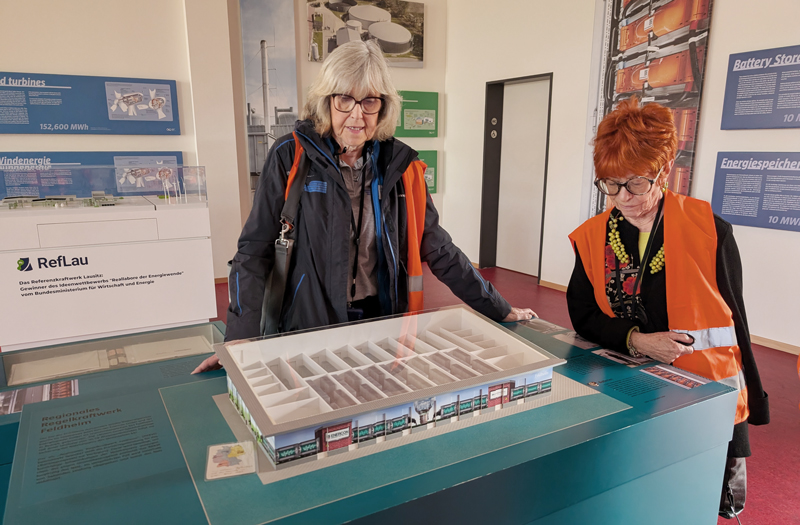
The people of Feldheim have also received corporate support while developing the non-profit organization New Energy Forum (Neue Energien Forum). The organization has helped to develop a community centre from a former inn in the village, adding dioramas, displays and hosting educational programming focused on energy development. It’s now a tourist stop.
“The buy-in (for new power) is definitely still there. The villagers are still very proud of what’s been achieved,” Thompson told Atlantic Business.
In the last few years, three new homes have been built in Feldheim. In all cases, though it was slightly more than the original connections, the owners opted to be connected to the local energy systems.
Asked why Feldheim and the surrounding communities haven’t seen the kind of industrial-scale proposals like those now tabled in Atlantic Canada, there is a simple answer: “There isn’t the land to do that,” Thompson said.
Through the years, there have been as many as 55 wind turbines in Feldheim. It’s back to 51 as of deadline for this piece, for a total of 116 MW in power producing capacity. As older wind power units reach the end of their useful lives and are replaced, larger units have been introduced, allowing for more power from fewer turbines. The latter is essential, because it limits the overall footprint and keeps wind turbines out of the commercial forest.
In Atlantic Canada, the pitch for large, new energy projects for export began really as a pitch for using local land not used for housing, agriculture or other industry for immense levels of power production. The power would be pushed into chemical production to package the electricity as energy (as ammonia) for export to other places, including Germany, in the way a refinery might produce barrels of a particular petroleum product for shipping.
For a sense of scale, consider the wind farm recently proposed by North Atlantic Refining Corp. for the Sunnyside area on the island of Newfoundland. This heavy industry-energy production project involves 45 wind turbines covering an estimated area of 4,600 hectares, or a total equivalent to 46 square kilometres. That’s compared to just 1,157 hectares or 11.6 square kilometres of total area for the Feldheim wind farm.
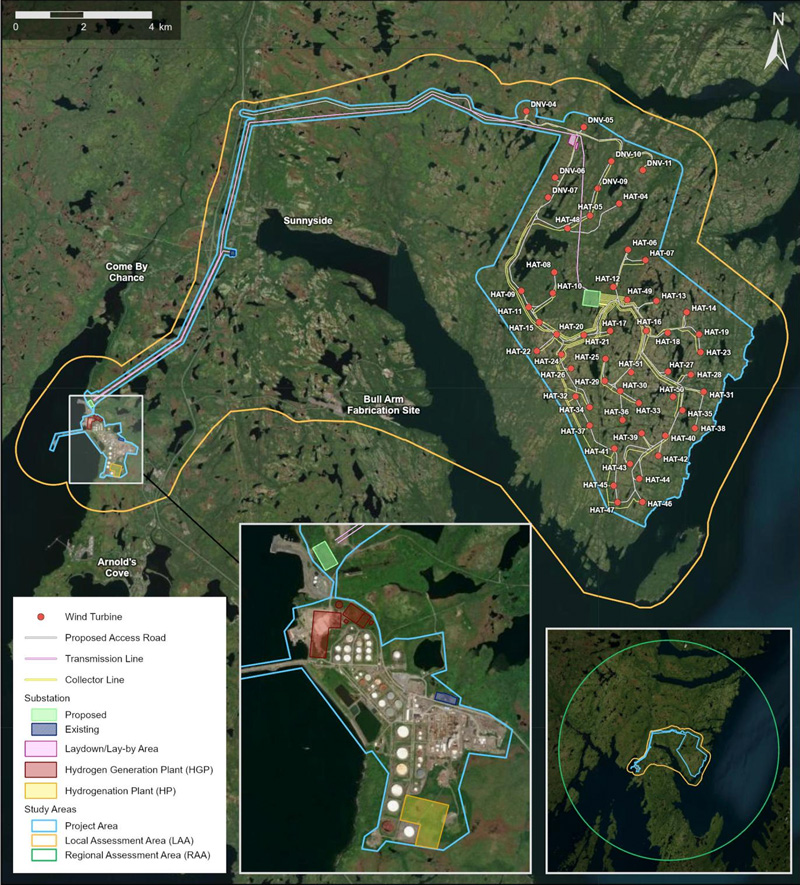
North Atlantic’s proposal—one of the smallest on tap in geographic reach—includes other industrial components. While reviewed independently, it sits alongside a separate proposal with hundreds of more turbines, and associated access roads, substations and other infrastructure around what’s known as the isthmus of the island of Newfoundland, where the land narrows in the division of the Avalon Peninsula from the rest of the island.

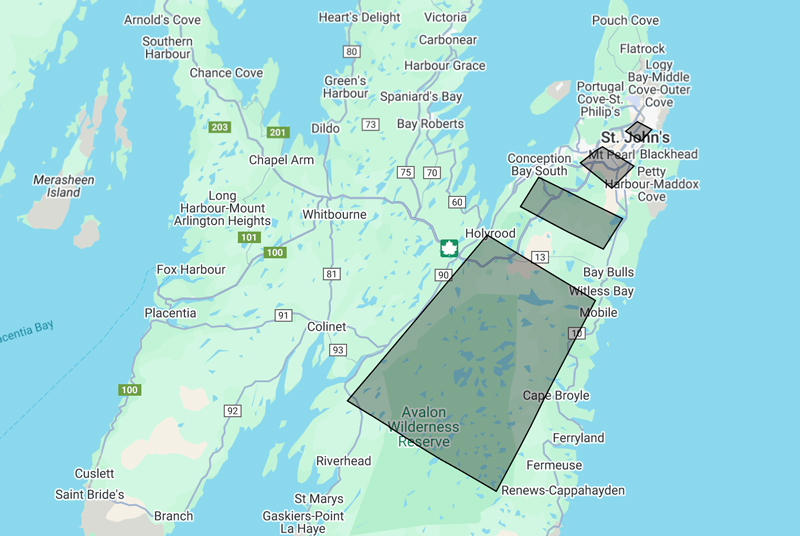
This is the Toqlukuti’k Avalon Isthmus Green Energy Project with 515 proposed wind turbines. The isthmus project is proposed by a partnership of Canadian arms of giants Copenhagen Energy Partners and ABO Energy. It’s not far from the Argentia Renewables project.
The latter is mainly on a brownfield site, with plans for 46 wind turbines at last update. It’s an example of how potential land use conflicts can become an opportunity for local partnerships, as with a trail project for local hikers, previously reported by Atlantic Business. It’s one of a thousand examples of specific site conflicts being identified and navigated with the people in Atlantic Canada as these megaprojects try to progress. These conflicts are related to social license, not the more explicit demands of environmental regulation or project engineering and financing.
Given the sheer scale, with the number and size of energy projects proposed, it’s no surprise some conflicts rise to the level of public disputes.
In achieving social license, a starting place is detailed information. In the case of EverWind’s initial proposal in Nova Scotia, there was no indication of exactly how the hydrogen production proposed would be powered when it came to placement of supporting power production facilities. The wind farms were announced separately, as permitted by environmental review laws.
In Newfoundland and Labrador, EverWind’s filing for a separate wind-hydrogen-energy export project included some information on wind power plans, but at a poorly defined level for local individuals, albeit acceptable at this stage of regulatory review. The lack of detail challenges the local discussions and debate. For a better sense of the scale of changes: the overall project area identified covers 268,319 hectares (or about 2,683 sq. kms); the wind turbines cover roughly 129,000 hectares (1,290 sq kms), or more than 111 times larger than the Feldheim wind farm area. The company says the actual project area, or “project footprint” and footprint for wind will be smaller still, but the public is only told it is “subject to further analysis,” meaning little understanding for what will be long-term, local reality.
EverWind has been working on it, engaging with local communities and people in both provinces.
Offshore wind development allows for even larger turbines on an even smaller footprint compared to onshore wind, but the scale of five gigawatts of new production capacity the Government of Nova Scotia is actively pushing for is not insignificant.
A usual, repetitive narrative has emerged with new energy projects proposed in Canada, and it fails to account for any difference in project scale or purpose. Essentially, there is local pushback to some degree, perhaps an objection tied to land use. A proponent company or often supportive locals may then label it as noise from “naysayers.”
“Not in my backyard” thinking—NIMBYism—is the common framing. In public debate, all objections are often dumped into a pile, with individuals objecting on specific projects and for a wide variety of reasons being told they just don’t want the construction in their own area. If it was somewhere else, the suggestion goes, they’d have no issue.
Individuals and grassroots organizations pushing back have argued detailed discussion rarely reaches the stage of meaningfully considering:
Ultimately, what is proposed overall for Atlantic Canada is not development for energy independence like in the German countryside at Feldheim. That is only a possible side effect if negotiated.
What is proposed in Canada is instead, first and foremost, a new layer of industrialization. These are oil refineries of the new energy order, with the goal of packaging energy to ship it internationally as a global commodity.
This kind of development, with new power at industrial scale, is arguably needed globally for the energy transition, as argued to governments back to at least the 1980s. But who builds, who benefits, and exactly how, is active discussion. Questions around sacrifice and benefits are relevant, even when the energy supply is directed to other parts of Canada or the United States.
Not all projects proposed for new power production in Canada will proceed. Indeed, an early rush of enthusiasm and aggressive timelines, responded to with “cautious optimism” by the business community, has already been tempered with delayed timelines and re-evaluations.
For its part, the Government of Newfoundland and Labrador has just made the related decision to extend the timeline for six energy companies with public proposals to pay to retain their large Crown land licences, extending Crown land reserves into 2026. Some companies, already in arrears on millions in payments for their land reserves, were granted extensions despite their outstanding bills to the province.
But some projects proceed and new projects are being tabled. The registration for the North Atlantic project for environmental assessment in Newfoundland and Labrador was made in mid-July, while the Toqlukuti’k project was registered for review at the end of that month. An initial decision from the provincial environment minister on the North Atlantic project — clearing the review hurdle or requiring further information — is overdue (or not publicly announced) as this story was filed. A similar decision on the Toqlukuti’k project is due Sept. 12.
The idea of international sales of energy from Atlantic Canada’s proposed projects has also received very public boosts from no less than Canadian Prime Minister Mark Carney. An official communiqué from the Prime Minister’s Office during his recent visit to Germany said the Government of Canada would see “advancing co-operation” on a Canada-Germany Hydrogen Alliance announced back in 2022.
Canada will, the PMO stated, “develop a transatlantic hydrogen trade corridor that supports the clean energy transition and strengthens energy security.”
Apart from the pure business angle, there are still issues around social license. And it remains unclear just yet what companies, what geographic areas and what people will ultimately opt to play a role in the Canadian end of the energy corridor—and to what specific, local benefit.
Similar Articles:
Comment policy
Comments are moderated to ensure thoughtful and respectful conversations. First and last names will appear with each submission; anonymous comments and pseudonyms will not be permitted.
By submitting a comment, you accept that Atlantic Business Magazine has the right to reproduce and publish that comment in whole or in part, in any manner it chooses. Publication of a comment does not constitute endorsement of that comment. We reserve the right to close comments at any time.
Cancel